Page 1 of 1
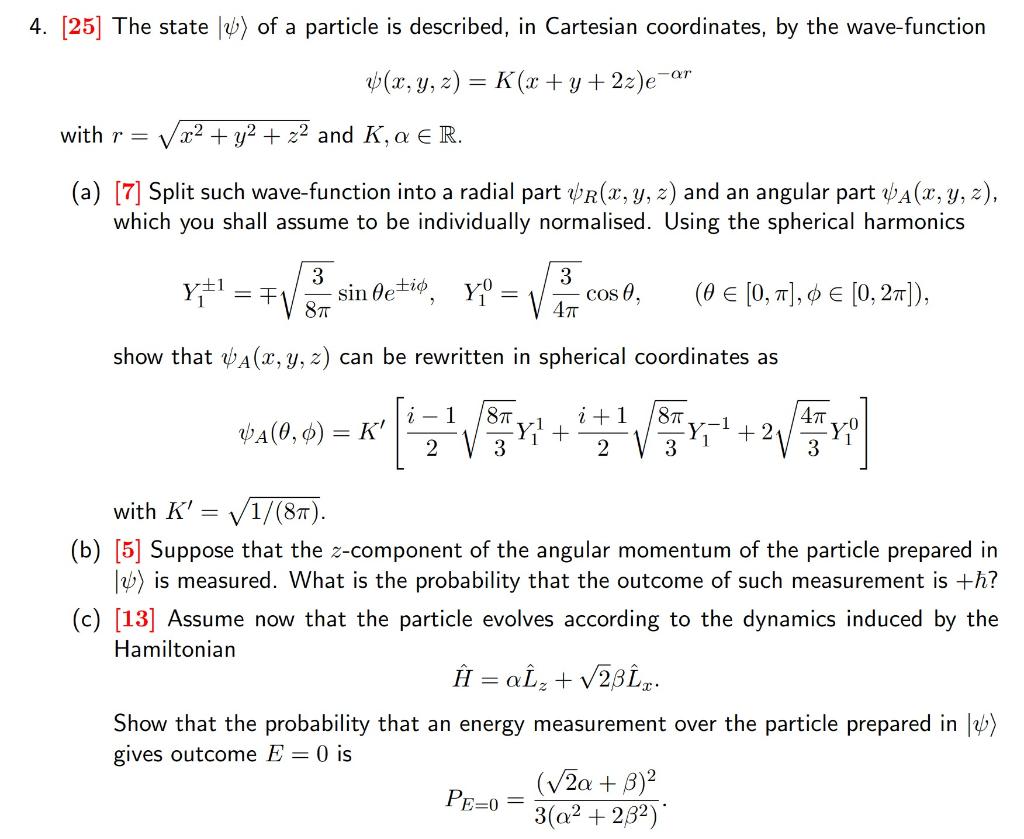
4. [25] The state [4) of a particle is described, in Cartesian coordinates, by the wave-function -ar *(x, y, z) = K(x +
Posted: Wed May 18, 2022 4:34 pm
by answerhappygod
- 4 25 The State 4 Of A Particle Is Described In Cartesian Coordinates By The Wave Function Ar X Y Z K X 1 (105.69 KiB) Viewed 45 times
4. [25] The state [4) of a particle is described, in Cartesian coordinates, by the wave-function -ar *(x, y, z) = K(x + y + 2z)e - with r= 2 + y2 + z2 and K, a ER. (a) [7] Split such wave-function into a radial part UR(x,y,z) and an angular part 0A(x, y, z), which you shall assume to be individually normalised. Using the spherical harmonics Y+1 = F1 - 3 87 sin deti Y; 3 cos , 47 (0 € [0, 1], 0 € [0, 27]), show that A(x, y, z) can be rewritten in spherical coordinates as 2 - 1 (87 VA(0,0) = K' *=[**** 871 i +1 2 3 -Y! + 2 -1 1 + 2 47 3 vo 3 with K' = /1/(87). (b) [5] Suppose that the z-component of the angular momentum of the particle prepared in |V) is measured. What is the probability that the outcome of such measurement is th? (C) [13] Assume now that the particle evolves according to the dynamics induced by the Hamiltonian ÎN = aÌ, + V2BÎx Show that the probability that an energy measurement over the particle prepared in 14) gives outcome E= 0 is (V2a + 3)2 3(Q2 +282) PE=0