Page 1 of 1
2. [25] Consider a particle of mass m confined to move within a region x € [0, a), outside of which it encounters an inf
Posted: Wed May 18, 2022 4:34 pm
by answerhappygod
- 2 25 Consider A Particle Of Mass M Confined To Move Within A Region X 0 A Outside Of Which It Encounters An Inf 1 (117.58 KiB) Viewed 46 times
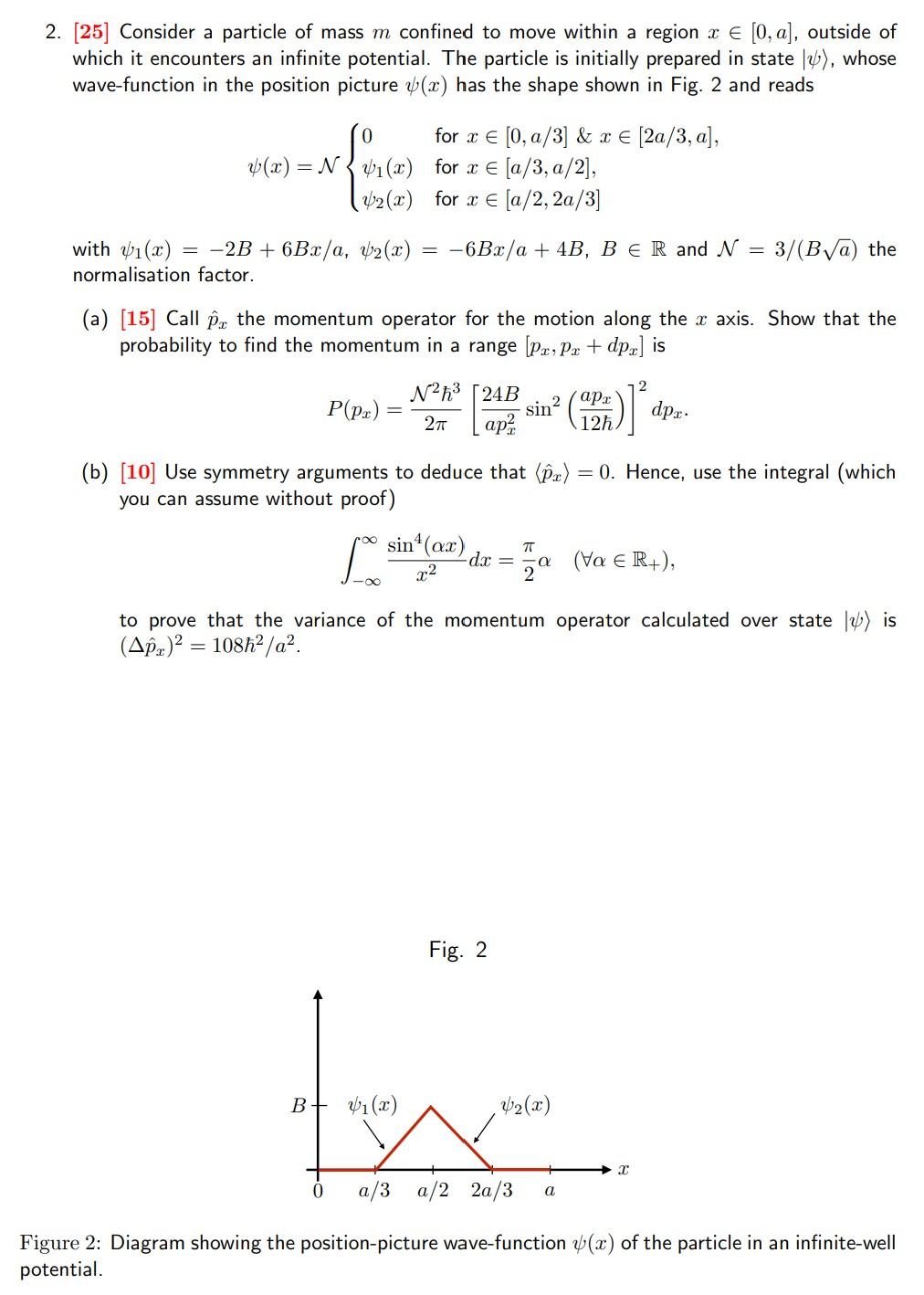
2. [25] Consider a particle of mass m confined to move within a region x € [0, a), outside of which it encounters an infinite potential. The particle is initially prepared in state [), whose wave-function in the position picture y(x) has the shape shown in Fig. 2 and reads for x € [0, a/3] & x € [2a/3, a), (x) = N 41(x) for x € [a/3, a/2), U2(x) for x € [a/2, 2a/3] with 41(c) = -2B + 6B.</a, 42(2) normalisation factor. -6Bx/a + 4B, B E R and N = 3/(Bva) the = (a) [15] Call Pc the momentum operator for the motion along the r axis. Show that the probability to find the momentum in a range (P2, P2 +dpx) is 2 P(px) = = Nh3 [24B 27 ap? sin 2 apr ]dpx ) 2h = (b) [10] Use symmetry arguments to deduce that (Pc) = 0. Hence, use the integral (which you can assume without proof) sinº (ar) 22 Fa (Va € R+), dr = TT -a to prove that the variance of the momentum operator calculated over state ) is (Apx)2 = 108h2/a- Fig. 2 Tema B+ 41(2) 02(x) C 0 a/3 a/2 20/3 a Figure 2: Diagram showing the position-picture wave-function 4(x) of the particle in an infinite-well potential.