- And Insulators Explain The Following A Sodium Which Has Two Atoms In A Bee Conven Tional Cubic Unit Cell Is A Me 1 (54.84 KiB) Viewed 52 times
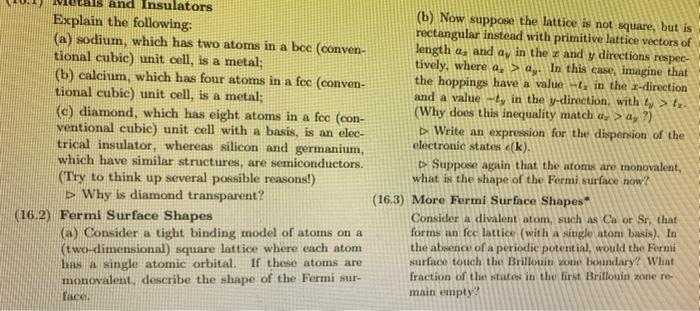
and Insulators Explain the following: (a) sodium, which has two atoms in a bee (conven- tional cubic) unit cell, is a metal; (b) calcium, which has four atoms in a foc (conven- tional cubic) unit cell, is a metal; (e) diamond, which has eight atoms in a fec (con- ventional cubic) unit cell with a basis, is an elec- trical insulator, whereas silicon and germanium, which have similar structures, are semiconductors. (Try to think up several possible reasons!) Why is diamond transparent? (16.2) Fermi Surface Shapes (a) Consider a tight binding model of atoms on a (two-dimensional) square lattice where each atom has a single atomic orbital. If these atoms are monovalent, describe the shape of the Fermi sur- face. (b) Now suppose the lattice is not square, but is rectangular instead with primitive lattice vectors of length 4, and ay in the z and y directions respec- tively, where a, > a,. In this case, imagine that the hoppings have a value - in the 2-direction and a value -ty in the y-direction, with Ly > fx (Why does this inequality match a. > 4, ?) Write an expression for the dispersion of the electronic states (k) D Suppose again that the atoms are monovalent, what is the shape of the Fermi surface now? (16.3) More Fermi Surface Shapes Consider a divalent atom, such as Ca or Sr, that forms an fee lattice (with a single atom basis). In the absence of a periodic potential, would the Fermi surface touch the Brillouin wone boundary? What fraction of the states in the first Brillouin zone re main empty?