Page 1 of 1
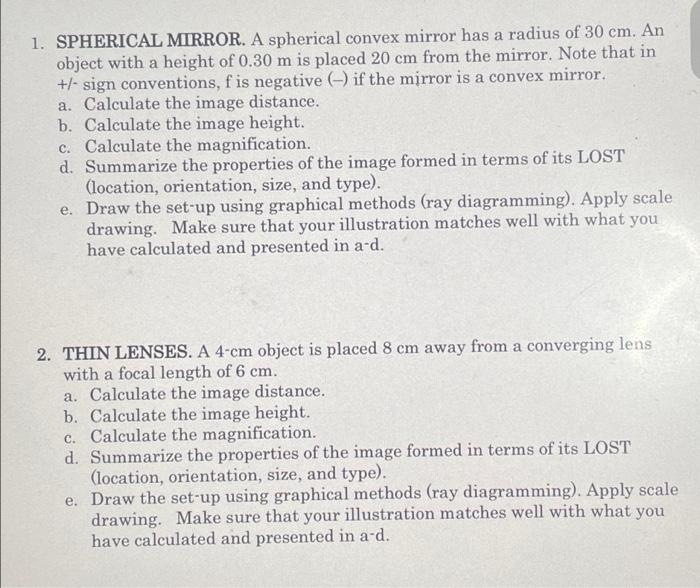
1. SPHERICAL MIRROR. A spherical convex mirror has a radius of 30 cm. An object with a height of 0.30 m is placed 20 cm
Posted: Wed May 18, 2022 4:27 pm
by answerhappygod
- 1 Spherical Mirror A Spherical Convex Mirror Has A Radius Of 30 Cm An Object With A Height Of 0 30 M Is Placed 20 Cm 1 (72.11 KiB) Viewed 52 times
1. SPHERICAL MIRROR. A spherical convex mirror has a radius of 30 cm. An object with a height of 0.30 m is placed 20 cm from the mirror. Note that in +/- sign conventions, f is negative (-) if the mirror is a convex mirror. a. Calculate the image distance. b. Calculate the image height. c. Calculate the magnification. d. Summarize the properties of the image formed in terms of its LOST (location, orientation, size, and type). e. Draw the set-up using graphical methods (ray diagramming). Apply scale drawing. Make sure that your illustration matches well with what you have calculated and presented in a d. 2. THIN LENSES. A 4-cm object is placed 8 cm away from a converging lens with a focal length of 6 cm. a. Calculate the image distance. b. Calculate the image height. c. Calculate the magnification. d. Summarize the properties of the image formed in terms of its LOST (location, orientation, size, and type). e. Draw the set-up using graphical methods (ray diagramming). Apply scale drawing. Make sure that your illustration matches well with what you have calculated and presented in a d.