Page 1 of 1
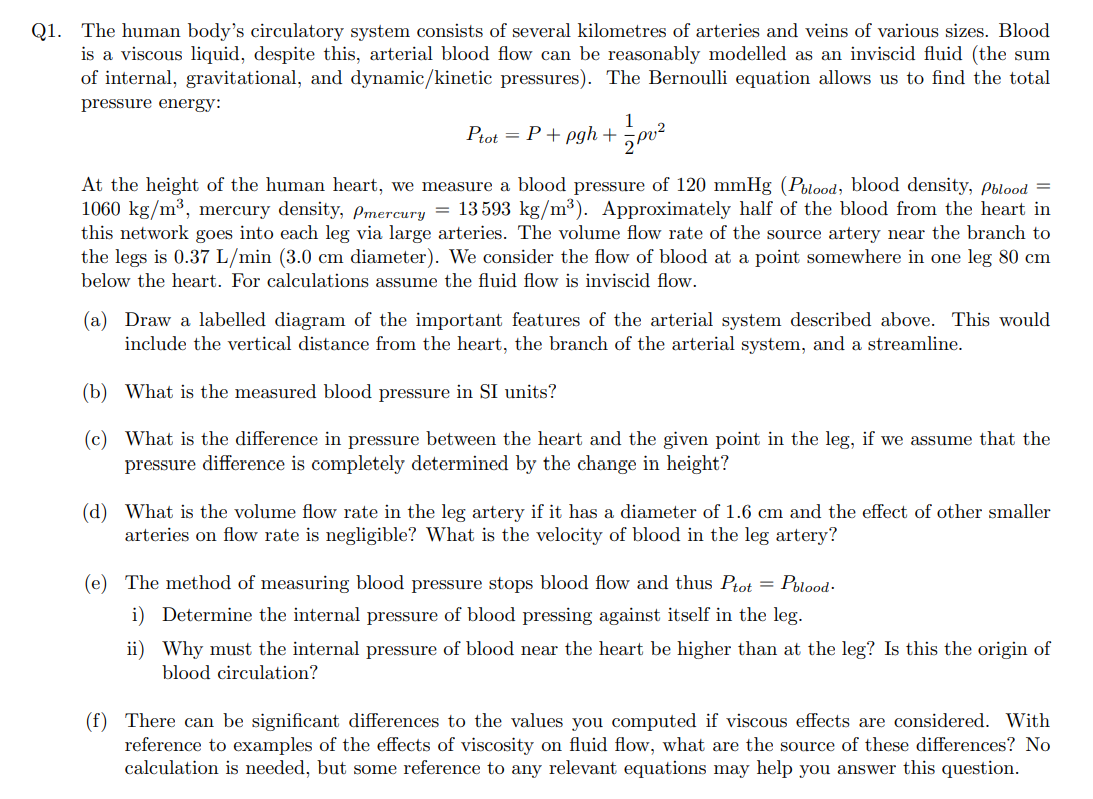
Q1. The human body's circulatory system consists of several kilometres of arteries and veins of various sizes. Blood is
Posted: Wed May 18, 2022 4:24 pm
by answerhappygod
- Q1 The Human Body S Circulatory System Consists Of Several Kilometres Of Arteries And Veins Of Various Sizes Blood Is 1 (231.45 KiB) Viewed 48 times
Q1. The human body's circulatory system consists of several kilometres of arteries and veins of various sizes. Blood is a viscous liquid, despite this, arterial blood flow can be reasonably modelled as an inviscid fluid (the sum of internal, gravitational, and dynamic/kinetic pressures). The Bernoulli equation allows us to find the total pressure energy: Ptot = P + pgh+3 po? At the height of the human heart, we measure a blood pressure of 120 mmHg (Pblood, blood density, Pblood = 1060 kg/m?, mercury density, Pmercury = 13593 kg/m3). Approximately half of the blood from the heart in this network goes into each leg via large arteries. The volume flow rate of the source artery near the branch to the legs is 0.37 L/min (3.0 cm diameter). We consider the flow of blood at a point somewhere in one leg 80 cm below the heart. For calculations assume the fluid flow is inviscid flow. (a) Draw a labelled diagram of the important features of the arterial system described above. This would include the vertical distance from the heart, the branch of the arterial system, and a streamline. (b) What is the measured blood pressure in SI units? (C) What is the difference in pressure between the heart and the given point in the leg, if we assume that the pressure difi ence is completely determined by the change in height? (d) What is the volume flow rate in the leg artery if it has a diameter of 1.6 cm and the effect of other smaller arteries on flow rate is negligible? What is the velocity of blood in the leg artery? (e) The method of measuring blood pressure stops blood flow and thus Ptot = Pblood. i) Determine the internal pressure of blood pressing against itself in the leg. ii) Why must the internal pressure of blood near the heart be higher than at the leg? Is this the origin of blood circulation? (f) There can be significant differences to the values you computed if viscous effects are considered. With reference to examples of the effects of viscosity on fluid flow, what are the source of these differences? No calculation is needed, but some reference to any relevant equations may help you answer this question.