Page 1 of 1
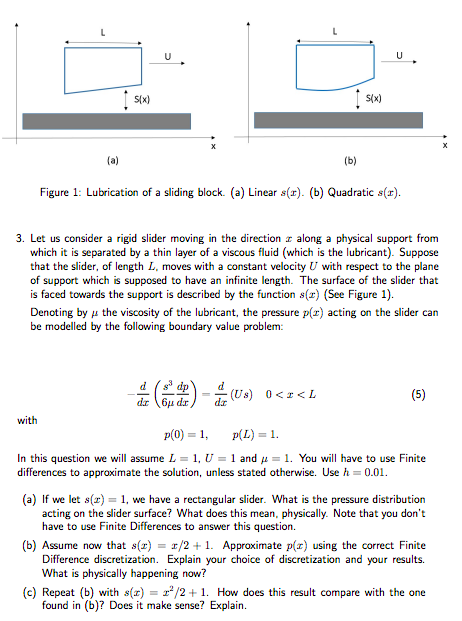
U S[x] I sxx) (a) (b) Figure 1: Lubrication of a sliding block. (a) Linear s(r). (b) Quadratic s(x). 3. Let us consider
Posted: Wed May 18, 2022 4:18 pm
by answerhappygod
- U S X I Sxx A B Figure 1 Lubrication Of A Sliding Block A Linear S R B Quadratic S X 3 Let Us Consider 1 (70.5 KiB) Viewed 38 times
U S[x] I sxx) (a) (b) Figure 1: Lubrication of a sliding block. (a) Linear s(r). (b) Quadratic s(x). 3. Let us consider a rigid slider moving in the direction : along a physical support from which it is separated by a thin layer of a viscous fluid (which is the lubricant). Suppose that the slider, of length L, moves with a constant velocity U with respect to the plane of support which is supposed to have an infinite length. The surface of the slider that is faced towards the support is described by the function $(x) (See Figure 1). Denoting by the viscosity of the lubricant, the pressure p(3) acting on the slider can be modelled by the following boundary value problem: ) - (US) 0<<L (5) de ouder with p(0) = 1, p(L) = 1. In this question we will assume L = 1, U = 1 and x = 1. You will have to use Finite differences to approximate the solution, unless stated otherwise. Use h=0.01. (a) If we let s(z) = 1, we have a rectangular slider. What is the pressure distribution acting on the slider surface? What does this mean, physically. Note that you don't have to use Finite Differences to answer this question. (b) Assume now that s(x) = 1/2+ 1. Approximate p(x) using the correct Finite Difference discretization. Explain your choice of discretization and your results. What is physically happening now? (c) Repeat (b) with s(x) = x</2+1. How does this result compare with the one found in (b)? Does it make sense? Explain.