Page 1 of 1
B. Content. Place a T in the blank for each true statement. Leave blanks empty for false statements. 1. Undersea lava fl
Posted: Wed May 18, 2022 4:07 pm
by answerhappygod
- B Content Place A T In The Blank For Each True Statement Leave Blanks Empty For False Statements 1 Undersea Lava Fl 1 (59.88 KiB) Viewed 41 times
- B Content Place A T In The Blank For Each True Statement Leave Blanks Empty For False Statements 1 Undersea Lava Fl 2 (59.88 KiB) Viewed 41 times
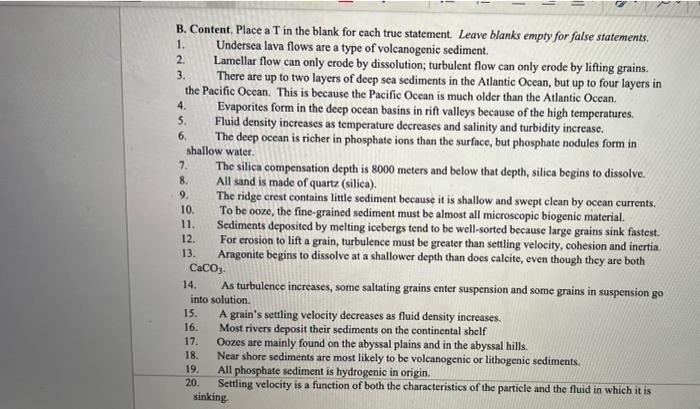
B. Content. Place a T in the blank for each true statement. Leave blanks empty for false statements. 1. Undersea lava flows are a type of volcanogenic sediment. 2. Lamellar flow can only erode by dissolution; turbulent flow can only erode by lifting grains. 3. There are up to two layers of deep sea sediments in the Atlantic Ocean, but up to four layers in the Pacific Ocean. This is because the Pacific Ocean is much older than the Atlantic Ocean. 4. Evaporites form in the deep ocean basins in rift valleys because of the high temperatures. 5. Fluid density increases as temperature decreases and salinity and turbidity increase. 6. The deep ocean is richer in phosphate ions than the surface, but phosphate nodules form in shallow water. 7. The silica compensation depth is 8000 meters and below that depth, silica begins to dissolve. 8. All sand is made of quartz (silica). 9. The ridge crest contains little sediment because it is shallow and swept clean by ocean currents. 10. To be ooze, the fine-grained sediment must be almost all microscopic biogenic material. 11. Sediments deposited by melting icebergs tend to be well-sorted because large grains sink fastest, 12. For erosion to lift a grain, turbulence must be greater than settling velocity, cohesion and inertia. Aragonite begins to dissolve at a shallower depth than does calcite, even though they are both CaCO3 As turbulence increases, some saltating grains enter suspension and some grains in suspension go 15. A grain's settling velocity decreases as fluid density increases. Most rivers deposit their sediments on the continental shelf Oozes are mainly found on the abyssal plains and in the abyssal hills. Near shore sediments are most likely to be volcanogenic or lithogenic sediments. All phosphate sediment is hydrogenic in origin. 20. Settling velocity is a function of both the characteristics of the particle and the fluid in which it is sinking 13. into solution 16. 17. 18. 19.