Page 1 of 1
16. Each chromosome has a constriction along its length called a) a centriole b) a centromere c) a centrosome d) a kinet
Posted: Wed May 18, 2022 3:36 pm
by answerhappygod
- 16 Each Chromosome Has A Constriction Along Its Length Called A A Centriole B A Centromere C A Centrosome D A Kinet 1 (65.84 KiB) Viewed 61 times
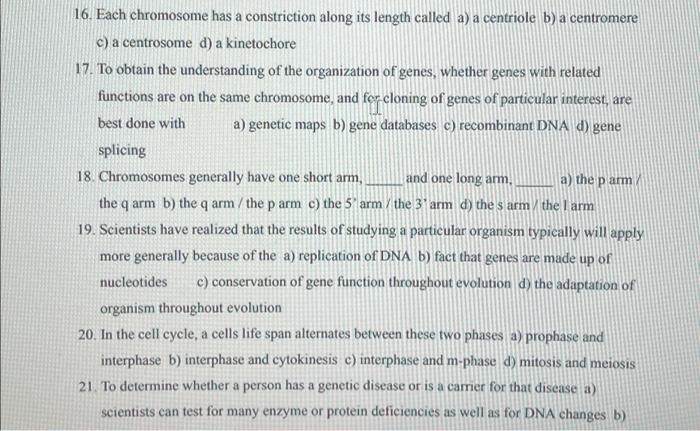
16. Each chromosome has a constriction along its length called a) a centriole b) a centromere c) a centrosome d) a kinetochore 17. To obtain the understanding of the organization of genes, whether genes with related functions are on the same chromosome, and for cloning of genes of particular interest, are best done with a) genetic maps b) gene databases c) recombinant DNA d) gene splicing 18. Chromosomes generally have one short arm, and one long arm. a) the p arm the q arm b) the q arm/the p arm c) the 5 arm/ the 3' arm d) the s arm the larm 19. Scientists have realized that the results of studying a particular organism typically will apply more generally because of the a) replication of DNA b) fact that genes are made up of nucleotides c) conservation of gene function throughout evolution d) the adaptation of organism throughout evolution 20. In the cell cycle, a cells life span alternates between these two phases a) prophase and interphase b) interphase and cytokinesis c) interphase and m-phase d) mitosis and meiosis 21. To determine whether a person has a genetic disease or is a carrier for that disease a) scientists can test for many enzyme or protein deficiencies as well as for DNA changes b)