Page 1 of 1
24. Steroids act on cells by what mechanism? A. binding surface receptors to activate a signaling cascade B. bind to sur
Posted: Wed May 18, 2022 2:20 pm
by answerhappygod
- 24 Steroids Act On Cells By What Mechanism A Binding Surface Receptors To Activate A Signaling Cascade B Bind To Sur 1 (66 KiB) Viewed 48 times
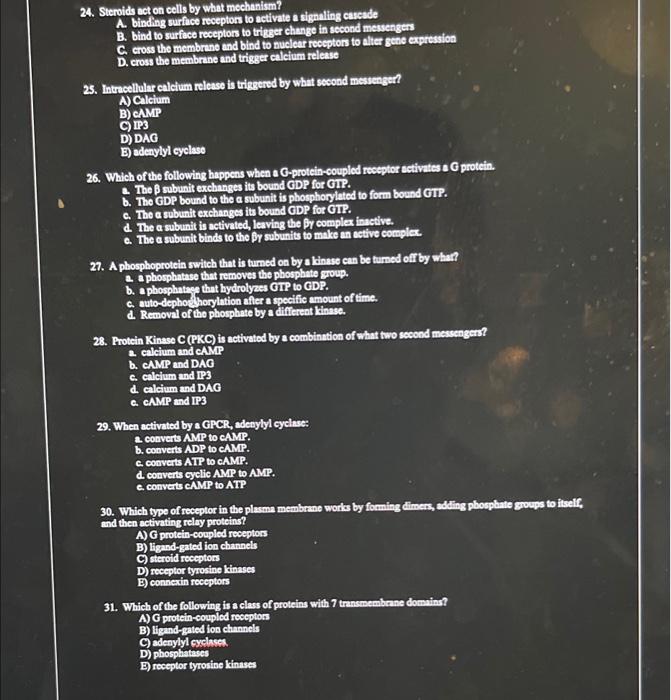
24. Steroids act on cells by what mechanism? A. binding surface receptors to activate a signaling cascade B. bind to surface receptors to trigger change in second messengers C cross the membrano and bind to nuclear receptors to alter gene expression D. cross the membrane and trigger calcium release 25. Intracellular calcium release is triggered by what second messenger? A) Calcium B) CAMP C) IP3 D) DAG E) adenylyl cyclase 26. Which of the following happens when a G-protein-coupled receptor activates G protein. The B subunit exchanges its bound GDP for GTP. b. The GDP bound to the a subunit is phosphorylated to form bound GTP. The a subunit exchanges its bound GDP for GTP. d. The a subunit is activated, leaving the By complex inactive. c. The a subunit binds to the By subunits to make an active complex 27. A phosphoprotein switch that is turned on by akinase can be turned off by what? 2 a phosphatase that removes the phosphate group. d. a phosphatase that hydrolyzes GTP to GDP. c. auto-dephoghorylation after a specific amount of time. d. Removal of the phosphate by a different kinase. 28. Protein kinase C (PKC) is activated by a combination of what two second messengers? & calcium and CAMP b. CAMP and DAG c. calcium and IP3 d. calcium and DAG Q. CAMP and IP3 29. When activated by a GPCR, adenylyl cyclase: 2 converts AMP to CAMP. b. converts ADP to CAMP. C. converts ATP to CAMP. d. converts cyclic AMP to AMP. c. converts CAMP to ATP 30. Which type of receptor in the plasma membrane works by forming dimers, adding phosphate groups to itself, and then activating relay proteins? A) G protein-coupled receptors B) ligand-galed ion channels C) steroid receptors D) receptor tyrosine kinases E) connexin receptors 31. Which of the following is a class of proteins with 7 transmembrane domains? A) G protein-coupled receptors B) ligand-gated ion channels Cadenylyl cyclases D) phosphatases E) receptor tyrosine kinases