Page 1 of 1
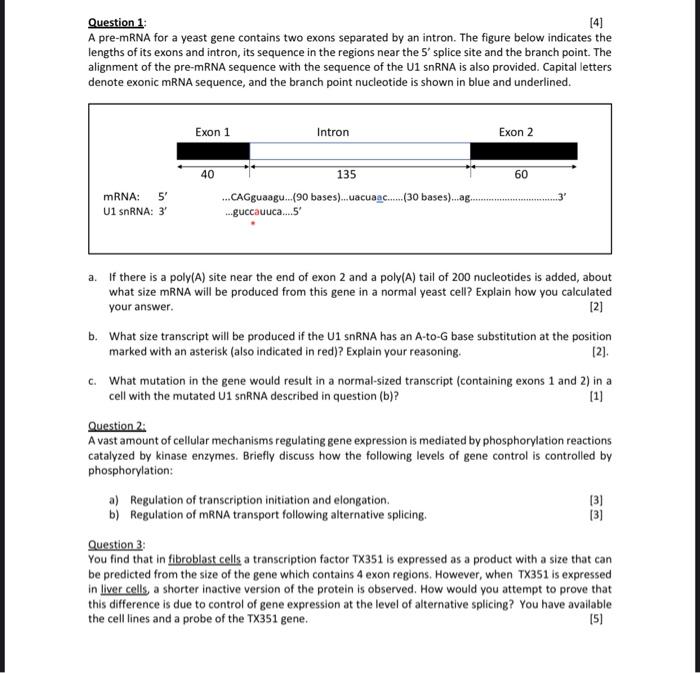
Question 1 [41 A pre-mRNA for a yeast gene contains two exons separated by an intron. The figure below indicates the len
Posted: Wed May 18, 2022 2:07 pm
by answerhappygod
- Question 1 41 A Pre Mrna For A Yeast Gene Contains Two Exons Separated By An Intron The Figure Below Indicates The Len 1 (71.11 KiB) Viewed 74 times
Question 1 [41 A pre-mRNA for a yeast gene contains two exons separated by an intron. The figure below indicates the lengths of its exons and intron, its sequence in the regions near the 5' splice site and the branch point. The alignment of the pre-mRNA sequence with the sequence of the U1 SnRNA is also provided. Capital letters denote exonic mRNA sequence, and the branch point nucleotide is shown in blue and underlined. Exon 1 Intron Exon 2 40 135 60 mRNA: 5 U1 SnRNA: 3 ...CAGguaagu.(90 bases ...uacuaac...(30 bases)..ag ...guccauca...5 a. If there is a poly(A) site near the end of exon 2 and a poly(A) tail of 200 nucleotides is added, about what size mRNA will be produced from this gene in a normal yeast cell? Explain how you calculated your answer. [21 b. What size transcript will be produced if the U1 SnRNA has an A-to-G base substitution at the position marked with an asterisk (also indicated in red)? Explain your reasoning. 12). c. What mutation in the gene would result in a normal-sized transcript (containing exons 1 and 2) in a cell with the mutated U1 snRNA described in question (b)? [11 Question 2: Avast amount of cellular mechanisms regulating gene expression is mediated by phosphorylation reactions catalyzed by kinase enzymes. Briefly discuss how the following levels of gene control is controlled by phosphorylation: a) Regulation of transcription initiation and elongation. 131 b) Regulation of mRNA transport following alternative splicing. (3) Question 3 You find that in fibroblast cells a transcription factor TX351 is expressed as a product with a size that can be predicted from the size of the gene which contains 4 exon regions. However, when TX351 is expressed in liver cells a shorter inactive version of the protein is observed. How would you attempt to prove that this difference is due to control of gene expression at the level of alternative splicing? You have available the cell lines and a probe of the TX351 gene. (5) a