Page 1 of 1
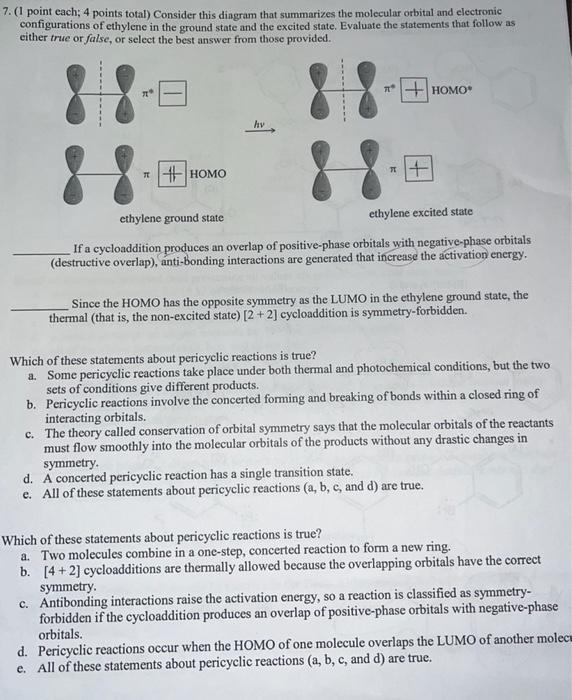
7.(1 point each; 4 points total) Consider this diagram that summarizes the molecular orbital and electronic configuratio
Posted: Wed May 18, 2022 12:41 pm
by answerhappygod
- 7 1 Point Each 4 Points Total Consider This Diagram That Summarizes The Molecular Orbital And Electronic Configuratio 1 (72.11 KiB) Viewed 102 times
7.(1 point each; 4 points total) Consider this diagram that summarizes the molecular orbital and electronic configurations of ethylene in the ground state and the excited state. Evaluate the statements that follow as either true or false, or select the best answer from those provided. # + HOMO hy 88 8 71 + номо TT + ethylene ground state ethylene excited state If a cycloaddition produces an overlap of positive-phase orbitals with negative-phase orbitals (destructive overlap), anti-bonding interactions are generated that increase the activation energy. Since the HOMO has the opposite symmetry as the LUMO in the ethylene ground state, the thermal (that is, the non-excited state) [2 + 2] cycloaddition is symmetry-forbidden. Which of these statements about pericyclic reactions is true? a. Some pericyclic reactions take place under both thermal and photochemical conditions, but the two sets of conditions give different products. b. Pericyclic reactions involve the concerted forming and breaking of bonds within a closed ring of interacting orbitals. c. The theory called conservation of orbital symmetry says that the molecular orbitals of the reactants must flow smoothly into the molecular orbitals of the products without any drastic changes in symmetry. d. A concerted pericyclic reaction has a single transition state. e. All of these statements about pericyclic reactions (a, b, c, and d) are true. Which of these statements about pericyclic reactions is true? a. Two molecules combine in a one-step, concerted reaction to form a new ring. b. [4 + 2) cycloadditions are thermally allowed because the overlapping orbitals have the correct symmetry c. Antibonding interactions raise the activation energy, so a reaction is classified as symmetry- forbidden if the cycloaddition produces an overlap of positive-phase orbitals with negative-phase orbitals. d. Pericyclic reactions occur when the HOMO of one molecule overlaps the LUMO of another molecu e. All of these statements about pericyclic reactions (a, b, c, and d) are true.