Page 1 of 1
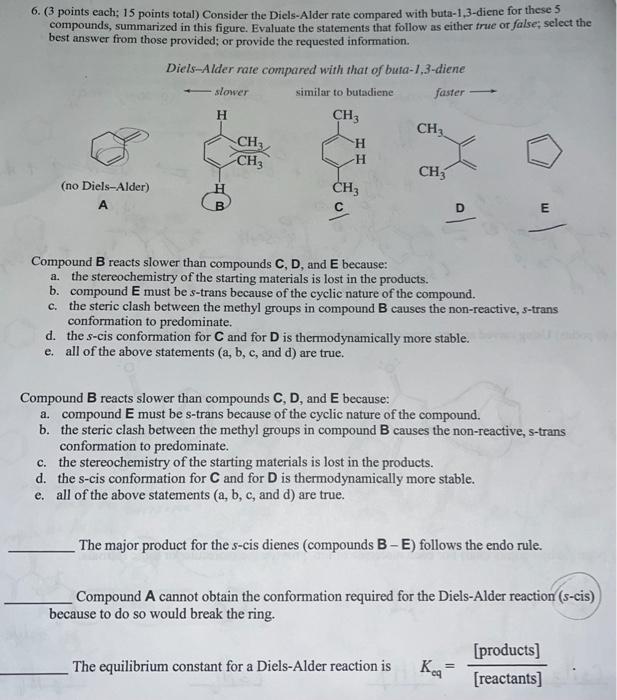
6. (3 points each: 15 points total) Consider the Diels-Alder rate compared with buta-1,3-diene for these 5 compounds, su
Posted: Wed May 18, 2022 12:40 pm
by answerhappygod
- 6 3 Points Each 15 Points Total Consider The Diels Alder Rate Compared With Buta 1 3 Diene For These 5 Compounds Su 1 (67.13 KiB) Viewed 40 times
6. (3 points each: 15 points total) Consider the Diels-Alder rate compared with buta-1,3-diene for these 5 compounds, summarized in this figure. Evaluate the statements that follow as either true or false; select the best answer from those provided; or provide the requested information. Diels-Alder rate compared with that of buta-1,3-diene slower similar to butadiene faster CH3 H CH3 CH CH3 H H CH; (no Diels-Alder) A CH; D E Compound B reacts slower than compounds C, D, and E because: a. the stereochemistry of the starting materials is lost in the products. b. compound E must be s-trans because of the cyclic nature of the compound. c. the steric clash between the methyl groups in compound B causes the non-reactive, s-trans conformation to predominate. d. the s-cis conformation for C and for D is thermodynamically more stable. e. all of the above statements (a, b, c, and d) are true. Compound B reacts slower than compounds C, D, and E because: a. compound E must be s-trans because of the cyclic nature of the compound. b. the steric clash between the methyl groups in compound B causes the non-reactive, s-trans conformation to predominate. c. the stereochemistry of the starting materials is lost in the products. d. the s-cis conformation for C and for D is thermodynamically more stable. e. all of the above statements (a, b, c, and d) are true. The major product for the s-cis dienes (compounds B-E) follows the endo rule. Compound A cannot obtain the conformation required for the Diels-Alder reaction (s-cis) because to do so would break the ring. The equilibrium constant for a Diels-Alder reaction is Ka [products) [reactants]