Page 1 of 1
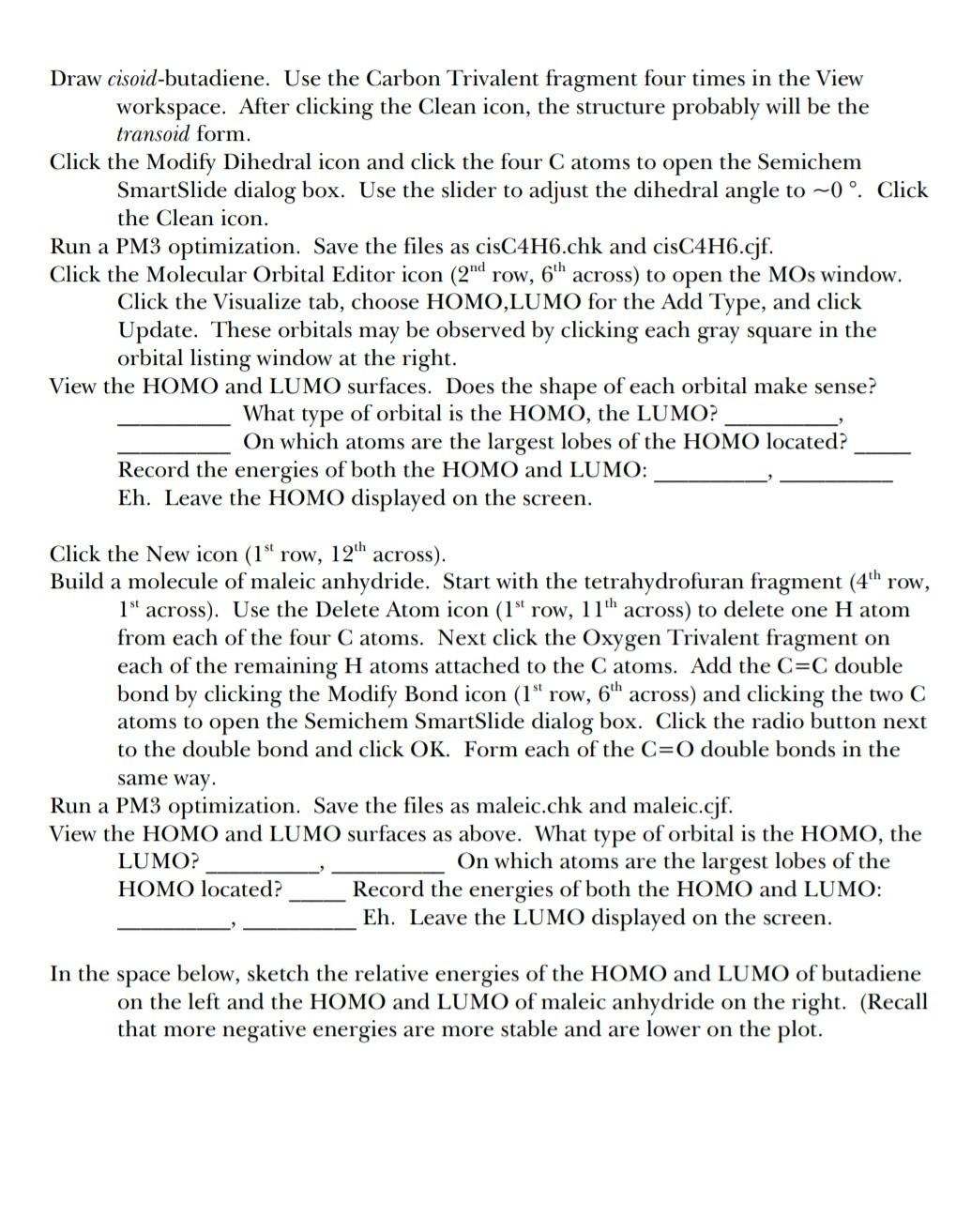
Draw cisoid-butadiene. Use the Carbon Trivalent fragment four times in the View workspace. After clicking the Clean icon
Posted: Wed May 18, 2022 11:10 am
by answerhappygod
- Draw Cisoid Butadiene Use The Carbon Trivalent Fragment Four Times In The View Workspace After Clicking The Clean Icon 1 (202.81 KiB) Viewed 63 times
Draw cisoid-butadiene. Use the Carbon Trivalent fragment four times in the View workspace. After clicking the Clean icon, the structure probably will be the transoid form. Click the Modify Dihedral icon and click the four C atoms to open the Semichem SmartSlide dialog box. Use the slider to adjust the dihedral angle to ~0° Click the Clean icon. Run a PM3 optimization. Save the files as cisC4H6.chk and cisC4H6.cjf. Click the Molecular Orbital Editor icon (2nd row, 6" across) to open the MOs window. Click the Visualize tab, choose HOMO,LUMO for the Add Type, and click Update. These orbitals may be observed by clicking each gray square in the orbital listing window at the right. View the HOMO and LUMO surfaces. Does the shape of each orbital make sense? What type of orbital is the HOMO, the LUMO? On which atoms are the largest lobes of the HOMO located? Record the energies of both the HOMO and LUMO: Eh. Leave the HOMO displayed on the screen. Click the New icon (1" row, 12th across). Build a molecule of maleic anhydride. Start with the tetrahydrofuran fragment (4th 1s across). Use the Delete Atom icon (1st row, 11th across) to delete one H atom from each of the four C atoms. Next click the Oxygen Trivalent fragment on each of the remaining H atoms attached to the C atoms. Add the C=C double bond by clicking the Modify Bond icon (1" row, 6th across) and clicking the two C atoms to open the Semichem SmartSlide dialog box. Click the radio button next to the double bond and click OK. Form each of the C=0 double bonds in the same way. Run a PM3 optimization. Save the files as maleic.chk and maleic.cjf. View the HOMO and LUMO surfaces as above. What type of orbital is the HOMO, the LUMO? On which atoms are the largest lobes of the HOMO located? Record the energies of both the HOMO and LUMO: Eh. Leave the LUMO displayed on the screen. row, In the space below, sketch the relative energies of the HOMO and LUMO of butadiene on the left and the HOMO and LUMO of maleic anhydride on the right. (Recall that more negative energies are more stable and are lower on the plot.