Page 1 of 1
Experiment B: Formation of tris (3,5-dimethylpyrazolyl) hydroborato molybdenum tricarbonyl anion The lengthy name of the
Posted: Wed May 18, 2022 10:20 am
by answerhappygod
- Experiment B Formation Of Tris 3 5 Dimethylpyrazolyl Hydroborato Molybdenum Tricarbonyl Anion The Lengthy Name Of The 1 (60.06 KiB) Viewed 73 times
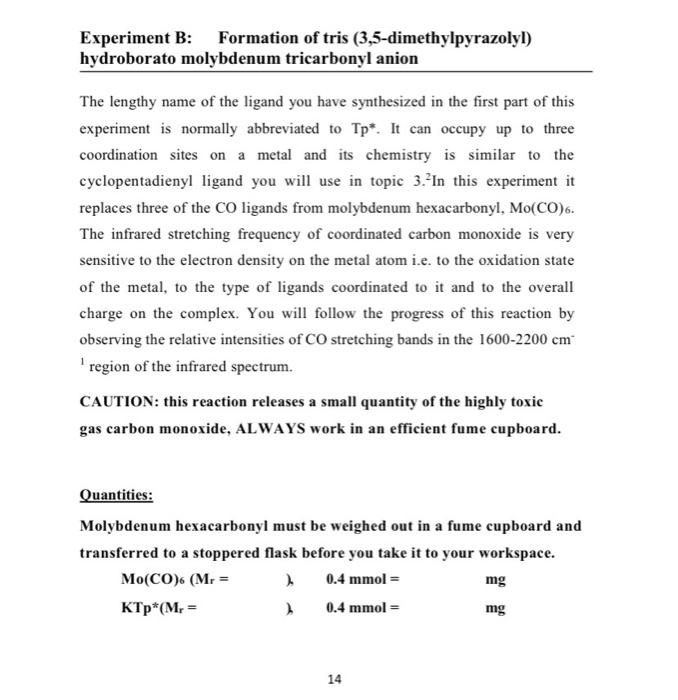
Experiment B: Formation of tris (3,5-dimethylpyrazolyl) hydroborato molybdenum tricarbonyl anion The lengthy name of the ligand you have synthesized in the first part of this experiment is normally abbreviated to Tp*. It can occupy up to three coordination sites on a metal and its chemistry is similar to the cyclopentadienyl ligand you will use in topic 3. In this experiment it replaces three of the CO ligands from molybdenum hexacarbonyl, Mo(CO).. The infrared stretching frequency of coordinated carbon monoxide is very sensitive to the electron density on the metal atom i.e. to the oxidation state of the metal, to the type of ligands coordinated to it and to the overall charge on the complex. You will follow the progress of this reaction by observing the relative intensities of CO stretching bands in the 1600-2200 cm region of the infrared spectrum. CAUTION: this reaction releases a small quantity of the highly toxic gas carbon monoxide, ALWAYS work in an efficient fume cupboard. Quantities: Molybdenum hexacarbonyl must be weighed out in a fume cupboard and transferred to a stoppered flask before you take it to your workspace. Mo(CO). (Mr = 1 0.4 mmol = mg KTp*(Mr = 0.4 mmol = mg = 14