Page 1 of 1
Procedure 1. Turn on the spectrophotometer to warm up the lamp for at least 15 min prior to use. Please use the same spe
Posted: Wed May 18, 2022 9:50 am
by answerhappygod
- Procedure 1 Turn On The Spectrophotometer To Warm Up The Lamp For At Least 15 Min Prior To Use Please Use The Same Spe 1 (251.73 KiB) Viewed 60 times
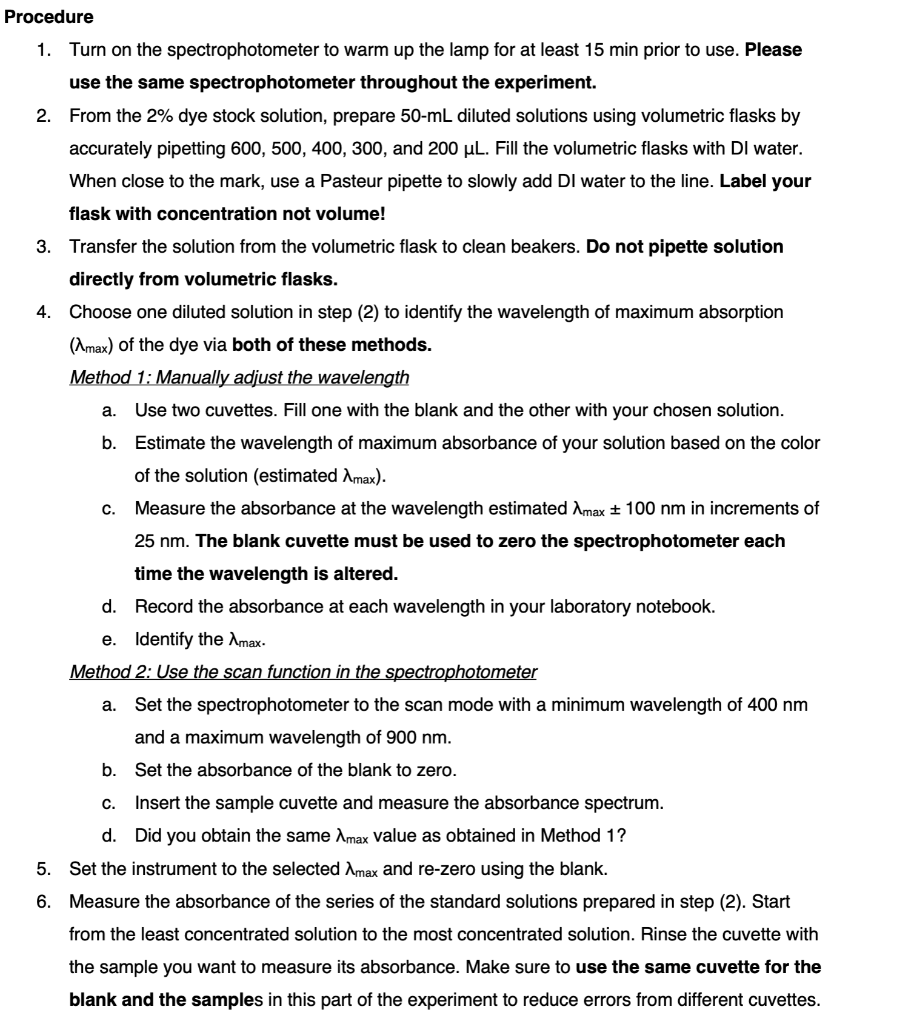
Procedure 1. Turn on the spectrophotometer to warm up the lamp for at least 15 min prior to use. Please use the same spectrophotometer throughout the experiment. 2. From the 2% dye stock solution, prepare 50-ml diluted solutions using volumetric flasks by accurately pipetting 600, 500, 400, 300, and 200 uL. Fill the volumetric flasks with Dl water. When close to the mark, use a Pasteur pipette to slowly add Dl water to the line. Label your flask with concentration not volume! 3. Transfer the solution from the volumetric flask to clean beakers. Do not pipette solution directly from volumetric flasks. 4. Choose one diluted solution in step (2) to identify the wavelength of maximum absorption (Amax) of the dye via both of these methods. Method 1: Manually adjust the wavelength a. Use two cuvettes. Fill one with the blank and the other with your chosen solution. b. Estimate the wavelength of maximum absorbance of your solution based on the color of the solution (estimated Imax). C. Measure the absorbance at the wavelength estimated Imax = 100 nm in increments of 25 nm. The blank cuvette must be used to zero the spectrophotometer each time the wavelength is altered. d. Record the absorbance at each wavelength in your laboratory notebook. e. Identify the Imax. Method 2: Use the scan function in the spectrophotometer a. Set the spectrophotometer to the scan mode with a minimum wavelength of 400 nm and a maximum wavelength of 900 nm. b. Set the absorbance of the blank to zero. c. Insert the sample cuvette and measure the absorbance spectrum. d. Did you obtain the same Amax value as obtained in Method 1? 5. Set the instrument to the selected Imax and re-zero using the blank. 6. Measure the absorbance of the series of the standard solutions prepared in step (2). Start from the least concentrated solution to the most concentrated solution. Rinse the cuvette with the sample you want to measure its absorbance. Make sure to use the same cuvette for the blank and the samples in this part of the experiment to reduce errors from different cuvettes.
No need to re-zero the spectrophotometer between measurements, because the measurements are carried out at the same wavelength. 7. Measure the absorbance of the unknown at the chosen Imax. 8. Record the absorbance of each solution in your laboratory notebook. Plot the curve of absorbance as a function of concentration. This is your standard calibration curve. See plotting guideline on page 20. 9. Perform a linear regression using any program of your choice, such as Microsoft Excel. Use the standard calibration curve to determine the concentration of the dye in the unknown.
1. How does a UV-Vis spectrophotometer work? Please describe the principles behind this technique. 2. What are the concentrations in %v/v of the solutions prepared in step (2)? Note that you are provided with a 2%v/v dye stock. 3. What will you use as the blank solution for this experiment? 4. Estimate the Imax for the red solution and the blue solution. 5. f your absorbance value is higher than 1.0 absorbance unit, indicating that the concentration of your sample is out of the linear range of the instrument. What should you do in order to accurately measure the absorbance of your sample?