- Time Evolution In A Particle Box Consider An M Mass Particle In A One Dimensional Box A Region And Assume That It Is I 1 (206.78 KiB) Viewed 97 times
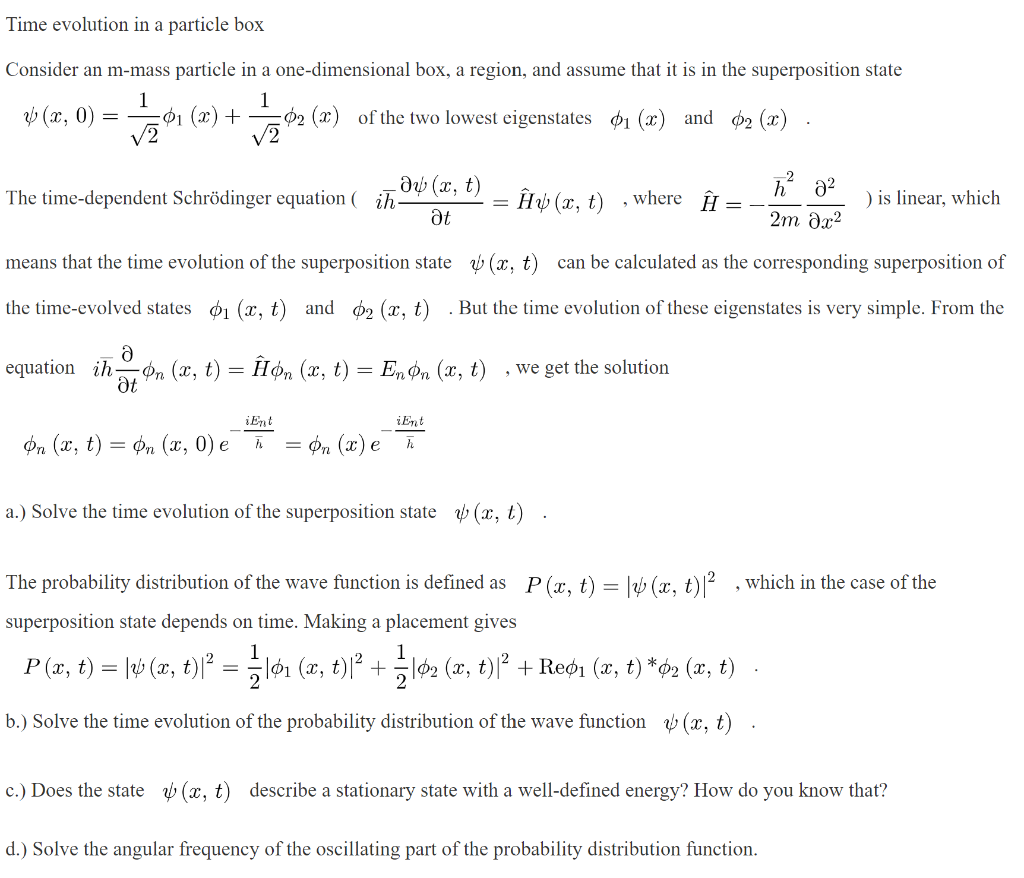
Time evolution in a particle box Consider an m-mass particle in a one-dimensional box, a region, and assume that it is in the superposition state 1 1 2(x, 0) vai 01 (2) + 02 (x) of the two lowest eigenstates 01 (3) and 02 (3) v (7(7) au (x, t) The time-dependent Schrödinger equation ( ih- at Îy (x, t) where H= h² az 2т да2 ) is linear, which means that the time evolution of the superposition state y (x, t) can be calculated as the corresponding superposition of the time-evolved states 01 (x, t) and 02 (x, t) . But the time evolution of these eigenstates is very simple. From the a equation in On (x, t) at În (x, t) = En On (x, t) , we get the solution iEnt Ent On (x, t) = On (x,0) e h = On (x) e a.) Solve the time evolution of the superposition state v(x, t) The probability distribution of the wave function is defined as P(x, t) = \\ (x, t)| , which in the case of the superposition state depends on time. Making a placement gives P(x, t) = luv (2, t)? = 5 l¢1 (8, t)/2 +162 (3, 4)]+ Reøı (x, t)*'» (x, t) b.) Solve the time evolution of the probability distribution of the wave function y(x, t) c.) Does the state (, t) describe a stationary state with a well-defined energy? How do you know that? d.) Solve the angular frequency of the oscillating part of the probability distribution function.