- A Problem 1 16 There Are Thought To Be Three Types Of The Particles Called Neutrinos Electron Type Ve Muon Type Vu 1 (69.84 KiB) Viewed 49 times
- A Problem 1 16 There Are Thought To Be Three Types Of The Particles Called Neutrinos Electron Type Ve Muon Type Vu 2 (19.51 KiB) Viewed 49 times
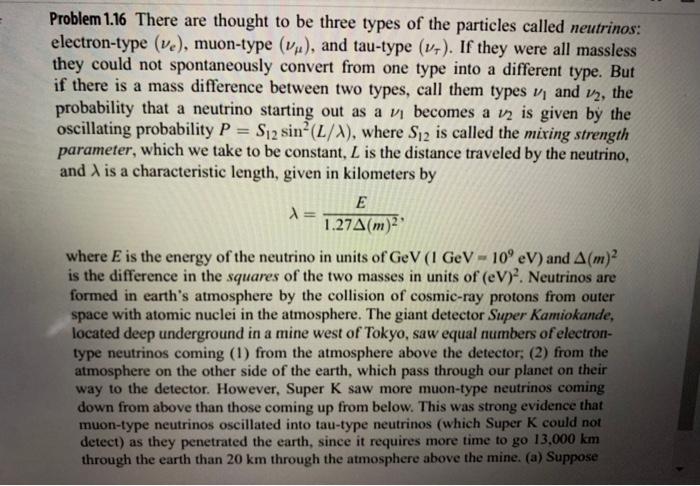
a Problem 1.16 There are thought to be three types of the particles called neutrinos: electron-type (ve), muon-type (vu), and tau-type (V+). If they were all massless they could not spontaneously convert from one type into a different type. But if there is a mass difference between two types, call them types », and v2, the probability that a neutrino starting out as a becomes a 12 is given by the oscillating probability P = S12 sin?(L/2), where Sı2 is called the mixing strength X parameter, which we take to be constant, L is the distance traveled by the neutrino, and X is a characteristic length, given in kilometers by E 1.27A(m)2 where E is the energy of the neutrino in units of GeV (1 GeV - 10° eV) and A(m)? is the difference in the squares of the two masses in units of (eV). Neutrinos are formed in earth's atmosphere by the collision of cosmic-ray protons from outer space with atomic nuclei in the atmosphere. The giant detector Super Kamiokande, located deep underground in a mine west of Tokyo, saw equal numbers of electron- type neutrinos coming (1) from the atmosphere above the detector; (2) from the atmosphere on the other side of the earth, which pass through our planet on their way to the detector. However, Super K saw more muon-type neutrinos coming down from above than those coming up from below. This was strong evidence that muon-type neutrinos oscillated into tau-type neutrinos (which Super K could not detect) as they penetrated the earth, since it requires more time to go 13,000 km through the earth than 20 km through the atmosphere above the mine. (a) Suppose a
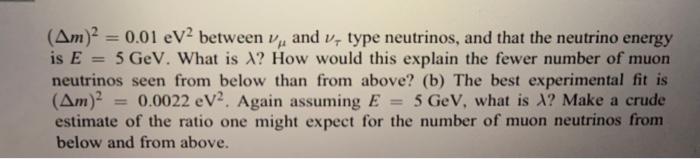
(Am) = 0.01 eV2 between V, and v, type neutrinos, and that the neutrino energy is E = 5 GeV. What is A? How would this explain the fewer number of muon neutrinos seen from below than from above? (b) The best experimental fit is (Am) 0.0022 eV?. Again assuming E 5 GeV, what is X? Make a crude estimate of the ratio one might expect for the number of muon neutrinos from below and from above.