Page 1 of 1
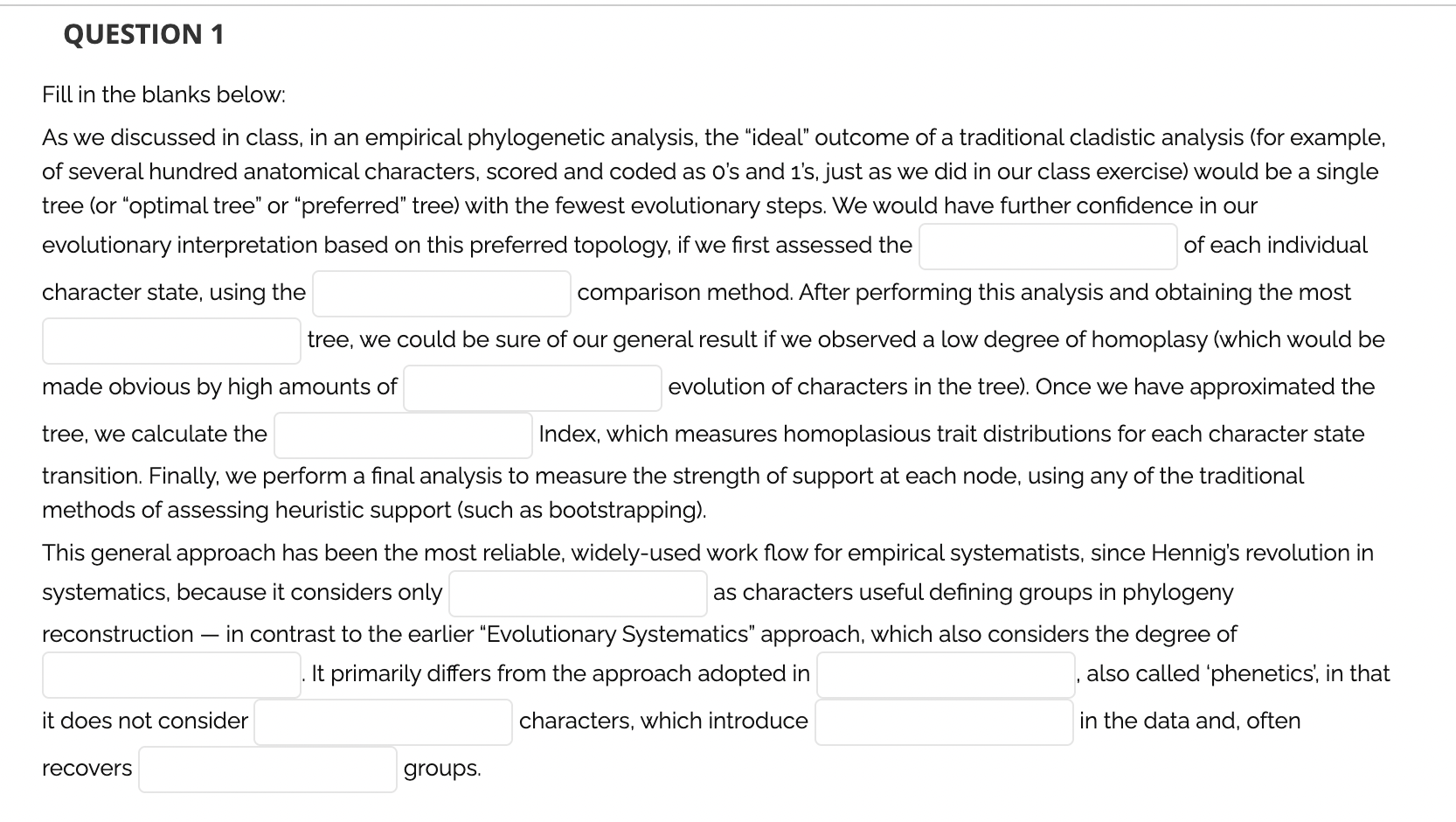
QUESTION 1 Fill in the blanks below: As we discussed in class, in an empirical phylogenetic analysis, the "ideal" outcom
Posted: Tue May 17, 2022 11:40 pm
by answerhappygod
- Question 1 Fill In The Blanks Below As We Discussed In Class In An Empirical Phylogenetic Analysis The Ideal Outcom 1 (512.94 KiB) Viewed 57 times
QUESTION 1 Fill in the blanks below: As we discussed in class, in an empirical phylogenetic analysis, the "ideal" outcome of a traditional cladistic analysis (for example, of several hundred anatomical characters, scored and coded as o's and 1's, just as we did in our class exercise) would be a single tree (or "optimal tree" or "preferred" tree) with the fewest evolutionary steps. We would have further confidence in our evolutionary interpretation based on this preferred topology, if we first assessed the of each individual character state, using the comparison method. After performing this analysis and obtaining the most tree, we could be sure of our general result if we observed a low degree of homoplasy (which would be made obvious by high amounts of evolution of characters in the tree). Once we have approximated the tree, we calculate the Index, which measures homoplasious trait distributions for each character state transition. Finally, we perform a final analysis to measure the strength of support at each node, using any of the traditional methods of assessing heuristic support (such as bootstrapping). This general approach has been the most reliable, widely-used work flow for empirical systematists, since Hennig's revolution in systematics, because it considers only as characters useful defining groups in phylogeny reconstruction – in contrast to the earlier "Evolutionary Systematics" approach, which also considers the degree of It primarily differs from the approach adopted in also called 'phenetics, in that it does not consider characters, which introduce in the data and, often recovers groups.