Page 1 of 1
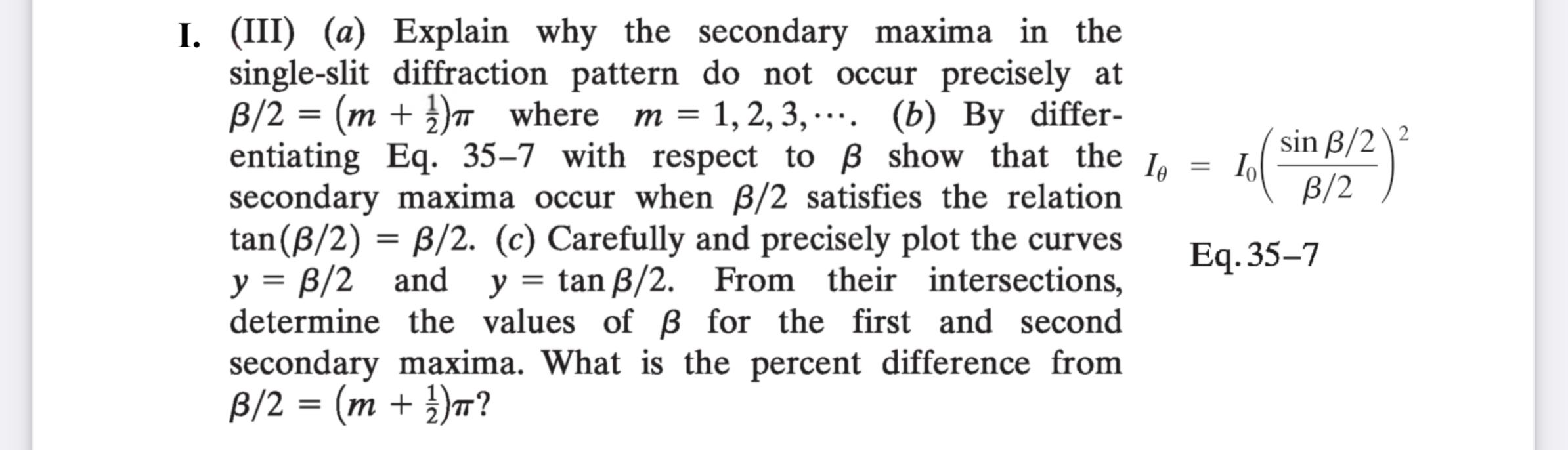
= le = 1,( sin ß/2)2 B/2 1. (III) (a) Explain why the secondary maxima in the single-slit diffraction pattern do not occ
Posted: Tue May 17, 2022 9:33 pm
by answerhappygod
- Le 1 Sin Ss 2 2 B 2 1 Iii A Explain Why The Secondary Maxima In The Single Slit Diffraction Pattern Do Not Occ 1 (127.98 KiB) Viewed 71 times
= le = 1,( sin ß/2)2 B/2 1. (III) (a) Explain why the secondary maxima in the single-slit diffraction pattern do not occur precisely at /+ B/2 = (m + ż) where m = 1, 2, 3,.... (b) By differ- entiating Eq. 35–7 with respect to B show that the secondary maxima occur when B/2 satisfies the relation tan(B/2) = B/2. (c) Carefully and precisely plot the curves y = B/2 and 3/2 y = tan ß/2. From their intersections, determine the values of B for the first and second secondary maxima. What is the percent difference from B/2 = (m + 3)? = Eq.35-7 = =