Page 1 of 1
The brine shrimp, Artemia salina, produces a larva which has density of 1.032 g/cm", and diameter of 0.4 mm. The larvae
Posted: Tue May 17, 2022 9:21 pm
by answerhappygod
- The Brine Shrimp Artemia Salina Produces A Larva Which Has Density Of 1 032 G Cm And Diameter Of 0 4 Mm The Larvae 1 (98.7 KiB) Viewed 74 times
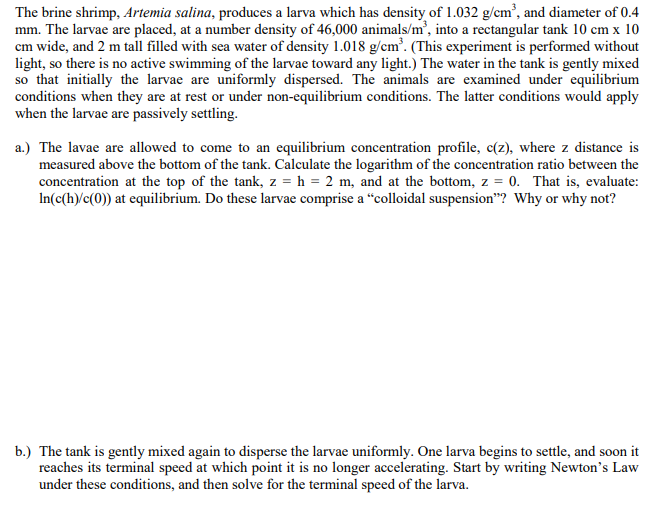
The brine shrimp, Artemia salina, produces a larva which has density of 1.032 g/cm", and diameter of 0.4 mm. The larvae are placed, at a number density of 46,000 animals/m, into a rectangular tank 10 cm x 10 cm wide, and 2 m tall filled with sea water of density 1.018 g/cm” (This experiment is performed without light, so there is no active swimming of the larvae toward any light.) The water in the tank is gently mixed so that initially the larvae are uniformly dispersed. The animals are examined under equilibrium conditions when they are at rest or under non-equilibrium conditions. The latter conditions would apply when the larvae are passively settling. a.) The lavae are allowed to come to an equilibrium concentration profile, c(z), where z distance is measured above the bottom of the tank. Calculate the logarithm of the concentration ratio between the concentration at the top of the tank, z = h = 2 m, and at the bottom, z = 0. That is, evaluate: In(c(h)/(0)) at equilibrium. Do these larvae comprise a "colloidal suspension"? Why or why not? b.) The tank is gently mixed again to disperse the larvae uniformly. One larva begins to settle, and soon it reaches its terminal speed at which point it is no longer accelerating. Start by writing Newton's Law under these conditions, and then solve for the terminal speed of the larva.