Page 1 of 1
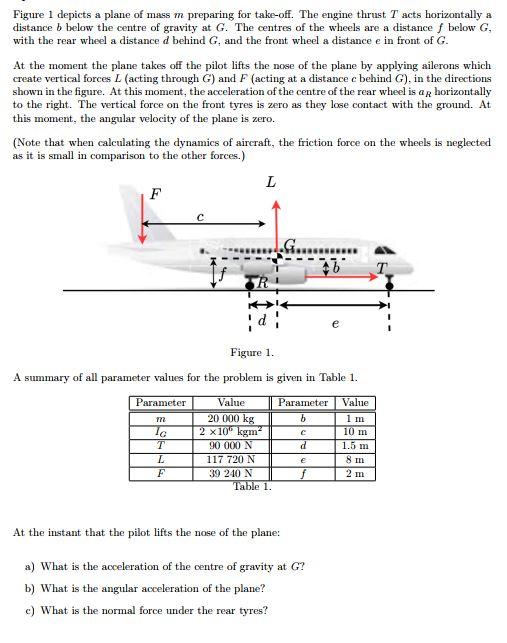
Figure 1 depicts a plane of mass m preparing for take-off. The engine thrust T acts horizontally a distance b below the
Posted: Tue May 17, 2022 9:10 pm
by answerhappygod
- Figure 1 Depicts A Plane Of Mass M Preparing For Take Off The Engine Thrust T Acts Horizontally A Distance B Below The 1 (54.01 KiB) Viewed 48 times
Figure 1 depicts a plane of mass m preparing for take-off. The engine thrust T acts horizontally a distance b below the centre of gravity at G. The centres of the wheels are a distance f below G, with the rear wheel a distance d behind G, and the front wheel a distance e in front of G. At the moment the plane takes off the pilot lifts the nose of the plane by applying ailerons which create vertical forces L (acting through G) and F (acting at a distance c behind G). in the directions shown in the figure. At this moment, the acceleration of the centre of the rear wheel is a R horizontally to the right. The vertical force on the front tyres is zero as they lose contact with the ground. At this moment, the angular velocity of the plane is zero. (Note that when calculating the dynamics of aircraft, the friction force on the wheels is neglected as it is small in comparison to the other forces.) L F di e Figure 1. A summary of all parameter values for the problem is given in Table 1. Parameter Value Parameter Value 20 000 kg b To 2 x 10 kgm 10 m T 90 000 N d 1.5 m I 117 720 N F 39 240 N f 2 m Table 1. m 1 m C e S m At the instant that the pilot lifts the nose of the plane: a) What is the acceleration of the centre of gravity at G? b) What is the angular acceleration of the plane? c) What is the normal force under the rear tyres?