Page 1 of 1
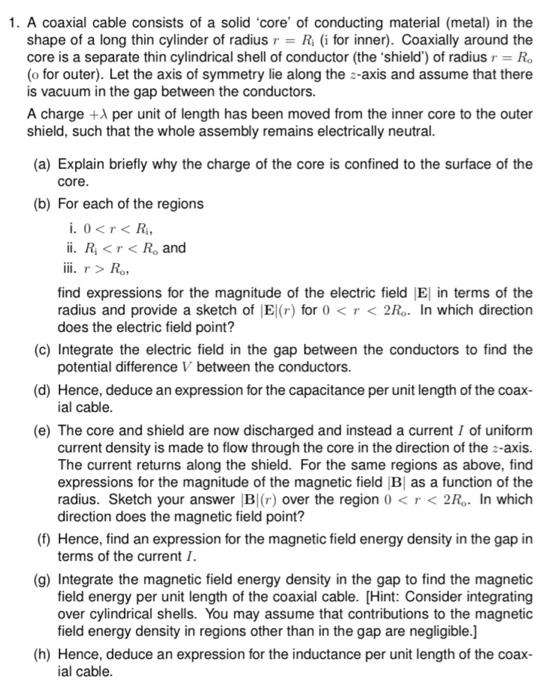
1. A coaxial cable consists of a solid 'core of conducting material (metal) in the shape of a long thin cylinder of radi
Posted: Tue May 17, 2022 9:03 pm
by answerhappygod
- 1 A Coaxial Cable Consists Of A Solid Core Of Conducting Material Metal In The Shape Of A Long Thin Cylinder Of Radi 1 (84.74 KiB) Viewed 46 times
1. A coaxial cable consists of a solid 'core of conducting material (metal) in the shape of a long thin cylinder of radius r = R: (i for inner). Coaxially around the core is a separate thin cylindrical shell of conductor (the "shield') of radius r = R. (o for outer). Let the axis of symmetry lie along the z-axis and assume that there is vacuum in the gap between the conductors. A charge +1 per unit of length has been moved from the inner core to the outer shield, such that the whole assembly remains electrically neutral. (a) Explain briefly why the charge of the core is confined to the surface of the core. (b) For each of the regions i. O<r<R ii. R <r <R, and iii. r > R. find expressions for the magnitude of the electric field |E| in terms of the radius and provide a sketch of E|(r) for 0 <r < 2R.. In which direction does the electric field point? (c) Integrate the electric field in the gap between the conductors to find the potential difference V between the conductors. (d) Hence, deduce an expression for the capacitance per unit length of the coax- ial cable. (e) The core and shield are now discharged and instead a current I of uniform current density is made to flow through the core in the direction of the z-axis. The current returns along the shield. For the same regions as above, find expressions for the magnitude of the magnetic field B as a function of the radius. Sketch your answer B(r) over the region 0 <r<2R.. In which direction does the magnetic field point? (1) Hence, find an expression for the magnetic field energy density in the gap in terms of the current I. (9) Integrate the magnetic field energy density in the gap to find the magnetic field energy per unit length of the coaxial cable. (Hint: Consider integrating over cylindrical shells. You may assume that contributions to the magnetic field energy density in regions other than in the gap are negligible.) (h) Hence, deduce an expression for the inductance per unit length of the coax- ial cable.