Page 1 of 1
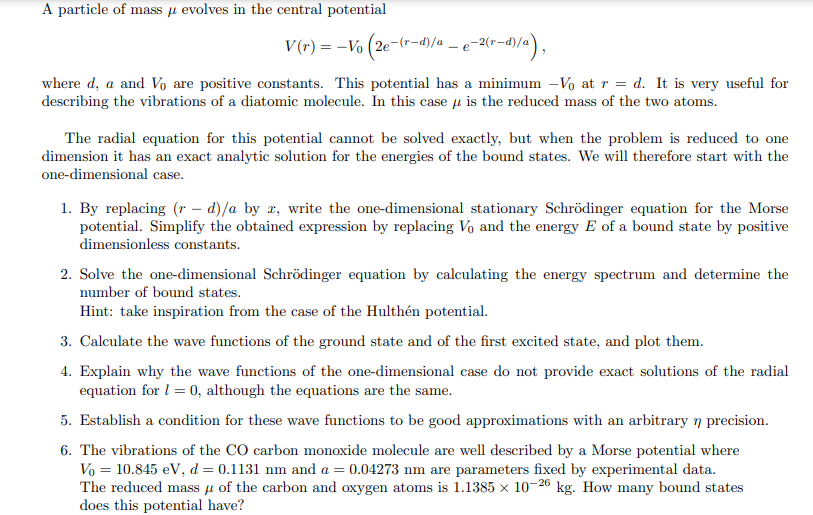
-27- A particle of mass y evolves in the central potential V(r) = -V. (2e-(–d)/4 – 6=261–d)/4), -/a where d, a and V, ar
Posted: Tue May 17, 2022 9:02 pm
by answerhappygod
- 27 A Particle Of Mass Y Evolves In The Central Potential V R V 2e D 4 6 261 D 4 A Where D A And V Ar 1 (131.28 KiB) Viewed 61 times
-27- A particle of mass y evolves in the central potential V(r) = -V. (2e-(–d)/4 – 6=261–d)/4), -/a where d, a and V, are positive constants. This potential has a minimum -V, at r = d. It is very useful for describing the vibrations of a diatomic molecule. In this case is the reduced mass of the two atoms. The radial equation for this potential cannot be solved exactly, but when the problem is reduced to one dimension it has an exact analytic solution for the energies of the bound states. We will therefore start with the one-dimensional case. 1. By replacing (r – d)/a by r, write the one-dimensional stationary Schrödinger equation for the Morse potential. Simplify the obtained expression by replacing V, and the energy E of a bound state by positive dimensionless constants. 2. Solve the one-dimensional Schrödinger equation by calculating the energy spectrum and determine the number of bound states. Hint: take inspiration from the case of the Hulthén potential. 3. Calculate the wave functions of the ground state and of the first excited state, and plot them. 4. Explain why the wave functions of the one-dimensional case do not provide exact solutions of the radial equation for 1 = 0, although the equations are the same. 5. Establish a condition for these wave functions to be good approximations with an arbitrary n precision. 6. The vibrations of the CO carbon monoxide molecule are well described by a Morse potential where Vo = 10.845 eV, d=0.1131 nm and a = 0.04273 nm are parameters fixed by experimental data. The reduced mass u of the carbon and oxygen atoms is 1.1385 x 10⁻²⁶ kg. How many bound states does this potential have?