- You Should Have In Front Of You An Oscilloscope A Signal Generator And An Electronics Kit With One 10 Pf Capacitor One 1 (59.46 KiB) Viewed 62 times
- You Should Have In Front Of You An Oscilloscope A Signal Generator And An Electronics Kit With One 10 Pf Capacitor One 2 (37.36 KiB) Viewed 62 times
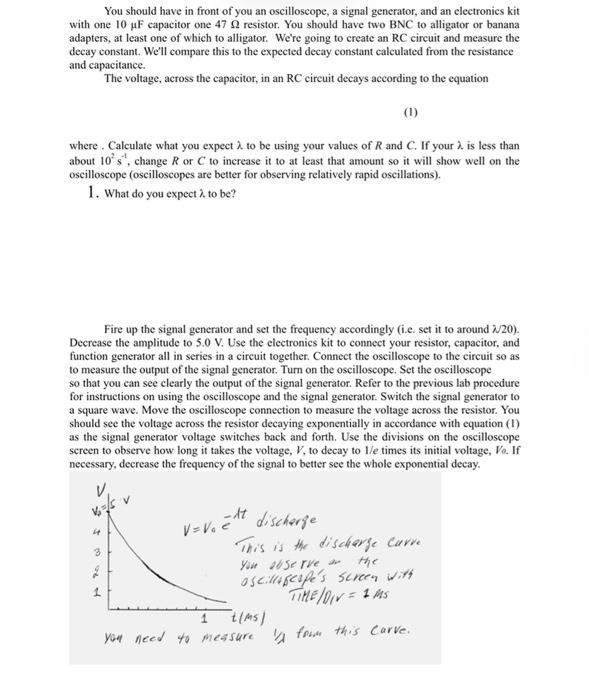
You should have in front of you an oscilloscope, a signal generator, and an electronics kit with one 10 pF capacitor one 47 2 resistor. You should have two BNC to alligator or banana adapters, at least one of which to alligator. We're going to create an RC circuit and measure the decay constant. We'll compare this to the expected decay constant calculated from the resistance and capacitance. The voltage, across the capacitor, in an RC circuit decays according to the equation (1) where . Calculate what you expect 2. to be using your values of Rand C. If your ) is less than about 10's', change R or C to increase it to at least that amount so it will show well on the oscilloscope (oscilloscopes are better for observing relatively rapid oscillations). 1. What do you expect , to be? Fire up the signal generator and set the frequency accordingly i.e. set it to around 1/20). Decrease the amplitude to 5.0 V. Use the electronics kit to connect your resistor, capacitor, and function generator all in series in a circuit together. Connect the oscilloscope to the circuit so as to measure the output of the signal generator. Turn on the oscilloscope. Set the oscilloscope so that you can see clearly the output of the signal generator. Refer to the previous la procedure for instructions on using the oscilloscope and the signal generator. Switch the signal generator to a square wave. Move the oscilloscope connection to measure the voltage across the resistor. You should see the voltage across the resistor decaying exponentially in accordance with equation (1) as the signal generator voltage switches back and forth. Use the divisions on the oscilloscope screen to observe how long it takes the voltage, V, to decay to Ile times its initial voltage, Vo. If necessary, decrease the frequency of the signal to better see the whole exponential decay. 4 3 V-V. discharge 3 1 This is the discharge curre Your 165erve the Oscillifeife's surten wilt Timelor = 1 MS tlms/ you need to measure for this carve. 1
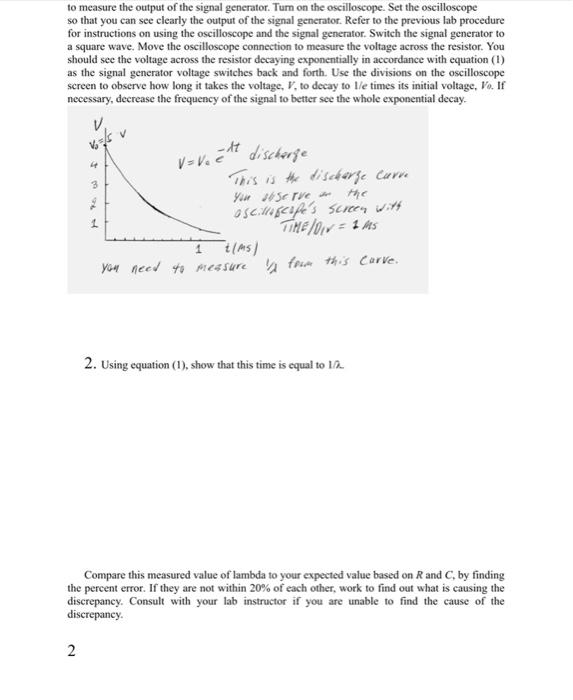
to measure the output of the signal generator. Tum on the oscilloscope. Set the oscilloscope so that you can see clearly the output of the signal generator. Refer to the previous lab procedure for instructions on using the oscilloscope and the signal generator. Switch the signal generator to a square wave. Move the oscilloscope connection to measure the voltage across the resistor. You should see the voltage across the resistor decaying exponentially in accordance with equation (1) as the signal generator voltage switches back and forth. Use the divisions on the oscilloscope screen to observe how long it takes the voltage, V, to decay to lle times its initial voltage, Vo. If necessary, decrease the frequency of the signal to better see the whole exponential decay. V lv de discharge 4 3 1 V=V. This is the discharfe Care Your 15 TV the asciufeipe's screen with TiMeloir = 1 MS t(MS) you need to measure for this Carve. 1 2. Using equation (1), show that this time is equal to 1 Compare this measured value of lambda to your expected value based on Rand C, by finding the percent error. If they are not within 20% of each other, work to find out what is causing the discrepancy. Consult with your lab instructor if you are unable to find the cause of the discrepancy. 2