Page 1 of 1
5. This question concerns the mass distribution of all gravitating matter in a galaxy. Having an analytic model for such
Posted: Tue May 17, 2022 8:30 pm
by answerhappygod
- 5 This Question Concerns The Mass Distribution Of All Gravitating Matter In A Galaxy Having An Analytic Model For Such 1 (282.84 KiB) Viewed 51 times
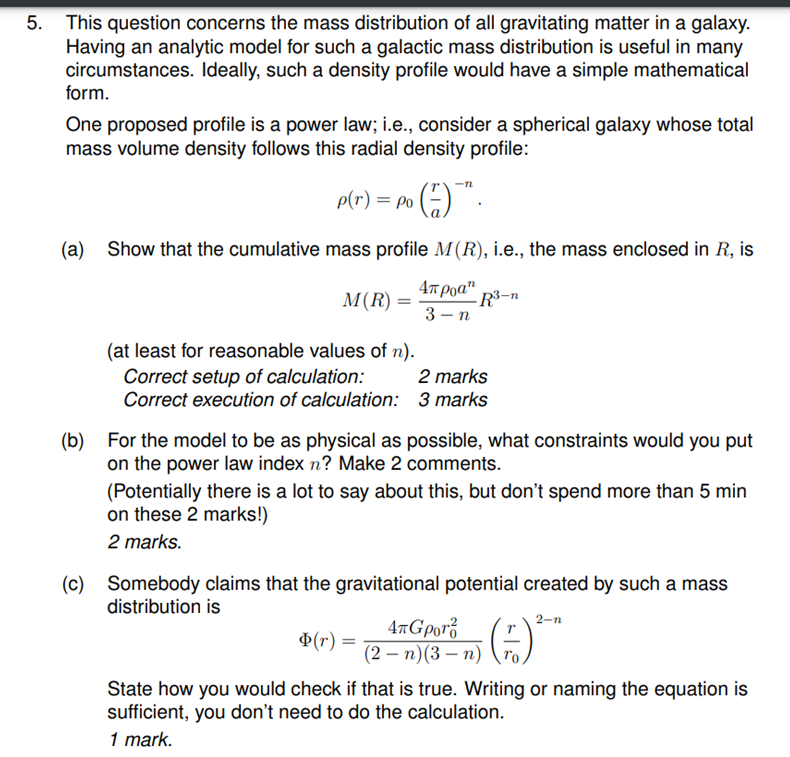
5. This question concerns the mass distribution of all gravitating matter in a galaxy. Having an analytic model for such a galactic mass distribution is useful in many circumstances. Ideally, such a density profile would have a simple mathematical form. One proposed profile is a power law; i.e., consider a spherical galaxy whose total mass volume density follows this radial density profile: --- p(r) = po p= (6) " (a) Show that the cumulative mass profile M(R), i.e., the mass enclosed in R, is R3-n 4προα" M(R) = 3-n (at least for reasonable values of n). Correct setup of calculation: 2 marks Correct execution of calculation: 3 marks (b) For the model to be as physical as possible, what constraints would you put on the power law index n? Make 2 comments. (Potentially there is a lot to say about this, but don't spend more than 5 min on these 2 marks!) 2 marks. (c) Somebody claims that the gravitational potential created by such a mass distribution is 2-n 4A Gpori (r) = (2 – n)(3 – n) (ro State how you would check if that is true. Writing or naming the equation is sufficient, you don't need to do the calculation. 1 mark.