Page 1 of 1
AaBbCcDdEe AaBbCcDdEe EE | == == = АавbccDC Аавьс Heading 1 Normal No Spacing Head A building has roof and occupied spac
Posted: Tue May 17, 2022 8:21 pm
by answerhappygod
- 1 (67.24 KiB) Viewed 35 times
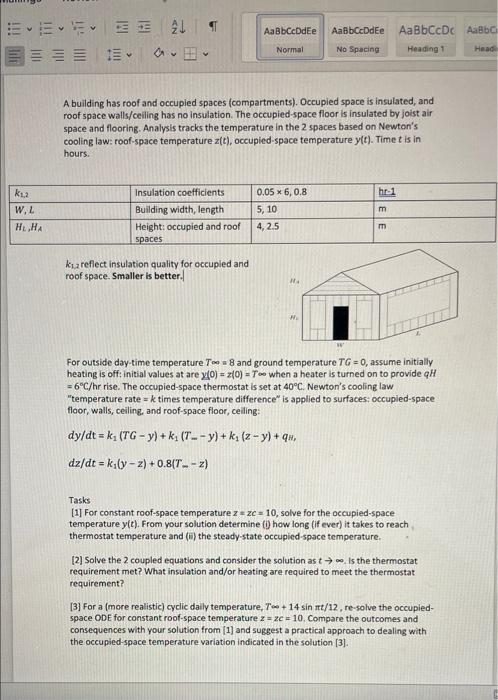
AaBbCcDdEe AaBbCcDdEe EE | == == = АавbccDC Аавьс Heading 1 Normal No Spacing Head A building has roof and occupied spaces (compartments). Occupied space is insulated, and roof space walls/ceiling has no insulation. The occupied-space floor is insulated by joist air space and flooring. Analysis tracks the temperature in the 2 spaces based on Newton's cooling law:roof-space temperature z(t), occupied space temperature y(t). Timet is in hours. hr1 k1,2 W.L HAHA Insulation coefficients Building width, length Height: occupied and roof spaces 0.05 x 6,0.8 5, 10 4,2.5 m ΕΕ m kuz reflect insulation quality for occupled and roof space. Smaller is better. For outside day-time temperature To = 8 and ground temperature TG = 0, assume initially heating is off: initial values at are y(0) = z[0) = To when a heater is turned on to provide qH = 6°C/hr rise. The occupied-space thermostat is set at 40°C. Newton's cooling law "temperature rate = k times temperature difference" is applied to surfaces: occupied-space floor, walls, ceiling, and roof space floor, ceiling: dy/dt = k, (TG - y) + k. (7-- y) + k, (2- y) + q. dz/dt = kz(y-2) +0.81T --z) Tasks [1] For constant roof-space temperature z = ze = 10, solve for the occupied-space temperature y(t). From your solution determine () how long (if ever) it takes to reach thermostat temperature and () the steady-state occupied-space temperature [2] Solve the 2 coupled equations and consider the solution as t— Is the thermostat requirement met? What insulation and/or heating are required to meet the thermostat requirement? [3] For a more realistic) cyclic daily temperature, 7+14 sin ft/12, re-solve the occupied space ODE for constant roof-space temperature z = 20 = 10. Compare the outcomes and consequences with your solution from (1) and suggest a practical approach to dealing with the occupied-space temperature variation indicated in the solution (3).