Page 1 of 1
In the 2015 science fiction film The Martian, astronaut Mark Watney is stranded on Mars on his own, left for dead. To es
Posted: Tue May 17, 2022 8:11 pm
by answerhappygod
- In The 2015 Science Fiction Film The Martian Astronaut Mark Watney Is Stranded On Mars On His Own Left For Dead To Es 1 (174.23 KiB) Viewed 82 times
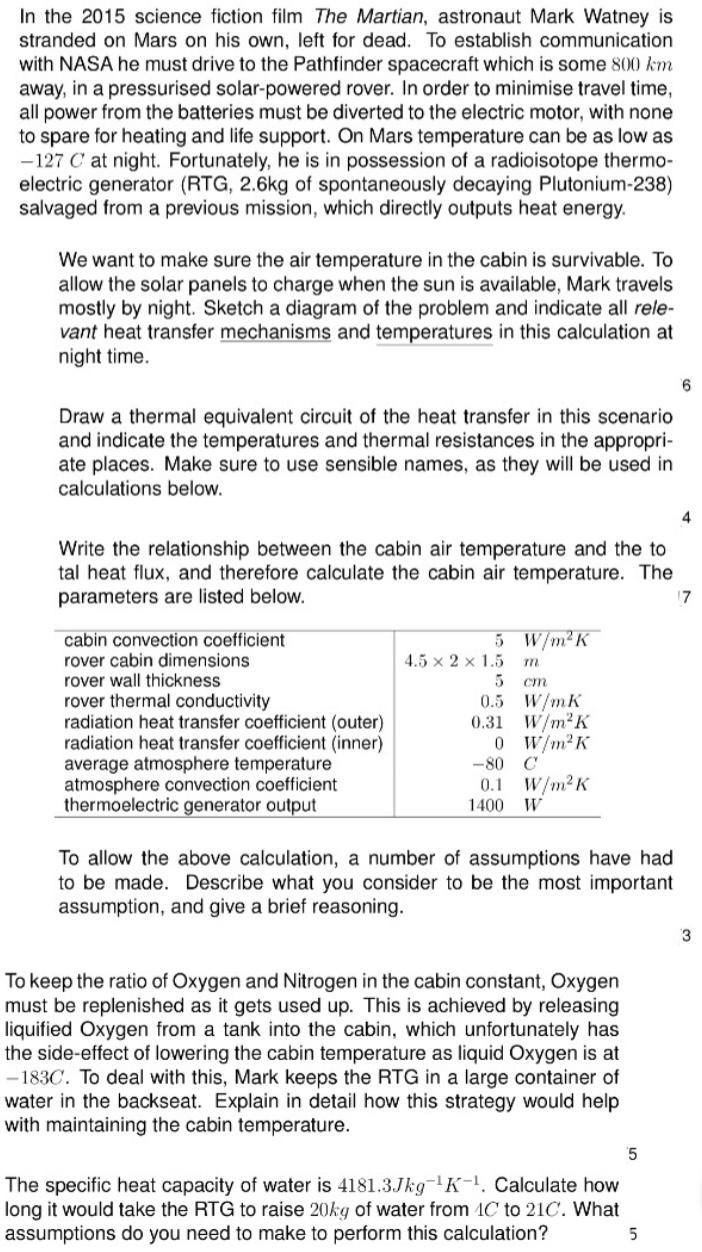
In the 2015 science fiction film The Martian, astronaut Mark Watney is stranded on Mars on his own, left for dead. To establish communication with NASA he must drive to the Pathfinder spacecraft which is some 800 km away, in a pressurised solar-powered rover. In order to minimise travel time, all power from the batteries must be diverted to the electric motor, with none to spare for heating and life support. On Mars temperature can be as low as - 127 C at night. Fortunately, he is in possession of a radioisotope thermo- electric generator (RTG, 2.6kg of spontaneously decaying Plutonium-238) salvaged from a previous mission, which directly outputs heat energy. We want to make sure the air temperature in the cabin is survivable. To allow the solar panels to charge when the sun is available, Mark travels mostly by night. Sketch a diagram of the problem and indicate all rele- vant heat transfer mechanisms and temperatures in this calculation at night time. Draw a thermal equivalent circuit of the heat transfer in this scenario and indicate the temperatures and thermal resistances in the appropri- ate places. Make sure to use sensible names, as they will be used in calculations below. 4 Write the relationship between the cabin air temperature and the to tal heat flux, and therefore calculate the cabin air temperature. The parameters are listed below. 17 m cabin convection coefficient rover cabin dimensions rover wall thickness rover thermal conductivity radiation heat transfer coefficient (outer) radiation heat transfer coefficient (inner) average atmosphere temperature atmosphere convection coefficient thermoelectric generator output 5 W/ mK 4.5 x 2 x 1.5 5 cm 0.5 W/mK 0.31 W/m2K 0 W/m2K -80 C 0.1 W/m2K 1400 w To allow the above calculation, a number of assumptions have had to be made. Describe what you consider to be the most important assumption, and give a brief reasoning. 3 To keep the ratio of Oxygen and Nitrogen in the cabin constant, Oxygen must be replenished as it gets used up. This is achieved by releasing liquified Oxygen from a tank into the cabin, which unfortunately has the side-effect of lowering the cabin temperature as liquid Oxygen is at -183C. To deal with this, Mark keeps the RTG in a large container of water in the backseat. Explain in detail how this strategy would help with maintaining the cabin temperature. 5 The specific heat capacity of water is 4181.3Jkg-K-I. Calculate how long it would take the RTG to raise 20kg of water from IC to 21C. What assumptions do you need to make to perform this calculation? 5