Page 1 of 1
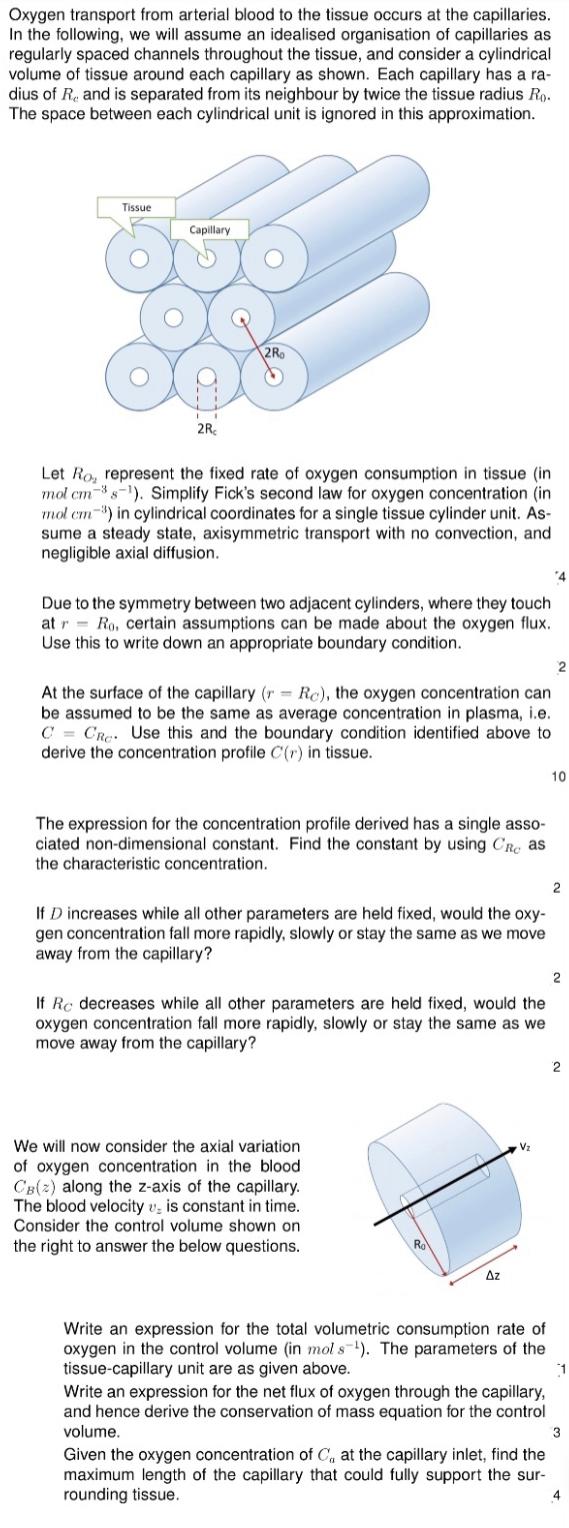
Oxygen transport from arterial blood to the tissue occurs at the capillaries. In the following, we will assume an ideali
Posted: Tue May 17, 2022 8:11 pm
by answerhappygod
- Oxygen Transport From Arterial Blood To The Tissue Occurs At The Capillaries In The Following We Will Assume An Ideali 1 (149.02 KiB) Viewed 100 times
Oxygen transport from arterial blood to the tissue occurs at the capillaries. In the following, we will assume an idealised organisation of capillaries as regularly spaced channels throughout the tissue, and consider a cylindrical volume of tissue around each capillary as shown. Each capillary has a ra- dius of Ra and is separated from its neighbour by twice the tissue radius Ro. The space between each cylindrical unit is ignored in this approximation. Tissue Capillary 2R. 2R Let Ro, represent the fixed rate of oxygen consumption in tissue (in molem-:-). Simplify Fick's second law for oxygen concentration (in molcm) in cylindrical coordinates for a single tissue cylinder unit. As- sume a steady state, axisymmetric transport with no convection, and a , negligible axial diffusion. 4 Due to the symmetry between two adjacent cylinders, where they touch at r = Ro, certain assumptions can be made about the oxygen flux. Use this to write down an appropriate boundary condition. 2 At the surface of the capillary (r = Rc), the oxygen concentration can be assumed to be the same as average concentration in plasma, i.e. C = Cre. Use this and the boundary condition identified above to derive the concentration profile C(r) in tissue. 10 The expression for the concentration profile derived has a single asso- ciated non-dimensional constant. Find the constant by using Creas the characteristic concentration, 2 If D increases while all other parameters are held fixed, would the oxy- gen concentration fall more rapidly, slowly or stay the same as we move away from the capillary? 2 If Rc decreases while all other parameters are held fixed, would the oxygen concentration fall more rapidly, slowly or stay the same as we move away from the capillary? 2 V We will now consider the axial variation of oxygen concentration in the blood CB(2) along the z-axis of the capillary. The blood velocity us is constant in time. Consider the control volume shown on the right to answer the below questions. Az Write an expression for the total volumetric consumption rate of oxygen in the control volume (in mol s-). The parameters of the tissue-capillary unit are as given above. 1 Write an expression for the net flux of oxygen through the capillary, and hence derive the conservation of mass equation for the control volume. 3 Given the oxygen concentration of C, at the capillary inlet, find the maximum length of the capillary that could fully support the sur- rounding tissue 4