Page 1 of 1
Cellular Respiration Accountant Answer the following questions under the assumption that each of the molecules undergoes
Posted: Tue May 17, 2022 3:50 pm
by answerhappygod
- Cellular Respiration Accountant Answer The Following Questions Under The Assumption That Each Of The Molecules Undergoes 1 (80.44 KiB) Viewed 161 times
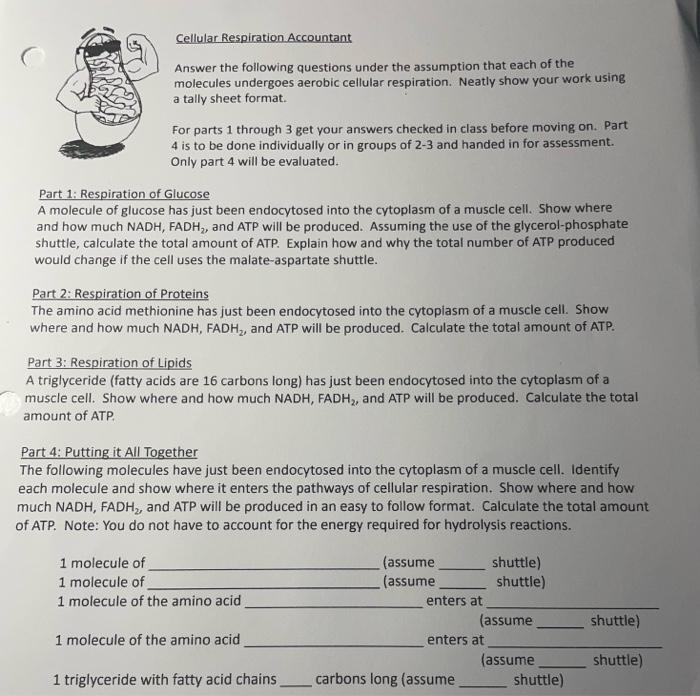
Cellular Respiration Accountant Answer the following questions under the assumption that each of the molecules undergoes aerobic cellular respiration. Neatly show your work using a tally sheet format For parts 1 through 3 get your answers checked in class before moving on. Part 4 is to be done individually or in groups of 2-3 and handed in for assessment. Only part 4 will be evaluated. Part 1: Respiration of Glucose A molecule of glucose has just been endocytosed into the cytoplasm of a muscle cell. Show where and how much NADH, FADH, and ATP will be produced. Assuming the use of the glycerol-phosphate shuttle, calculate the total amount of ATP. Explain how and why the total number of ATP produced would change if the cell uses the malate-aspartate shuttle. Part 2: Respiration of Proteins The amino acid methionine has just been endocytosed into the cytoplasm of a muscle cell. Show where and how much NADH, FADHy, and ATP will be produced. Calculate the total amount of ATP. Part 3: Respiration of Lipids A triglyceride (fatty acids are 16 carbons long) has just been endocytosed into the cytoplasm of a muscle cell. Show where and how much NADH, FADH2, and ATP will be produced. Calculate the total amount of ATP Part 4: Putting it All Together The following molecules have just been endocytosed into the cytoplasm of a muscle cell. Identify each molecule and show where it enters the pathways of cellular respiration. Show where and how much NADH, FADHy, and ATP will be produced in an easy to follow format. Calculate the total amount of ATP. Note: You do not have to account for the energy required for hydrolysis reactions. 1 molecule of 1 molecule of 1 molecule of the amino acid (assume shuttle) (assume shuttle) enters at (assume enters at (assume carbons long (assume shuttle) shuttle) 1 molecule of the amino acid shuttle) 1 triglyceride with fatty acid chains