Page 1 of 1
Name: 3. A Severinghaus electrode is used to measure the carbonic acid concentration in a solution (the solution could b
Posted: Tue May 17, 2022 12:36 pm
by answerhappygod
- Name 3 A Severinghaus Electrode Is Used To Measure The Carbonic Acid Concentration In A Solution The Solution Could B 1 (182.88 KiB) Viewed 98 times
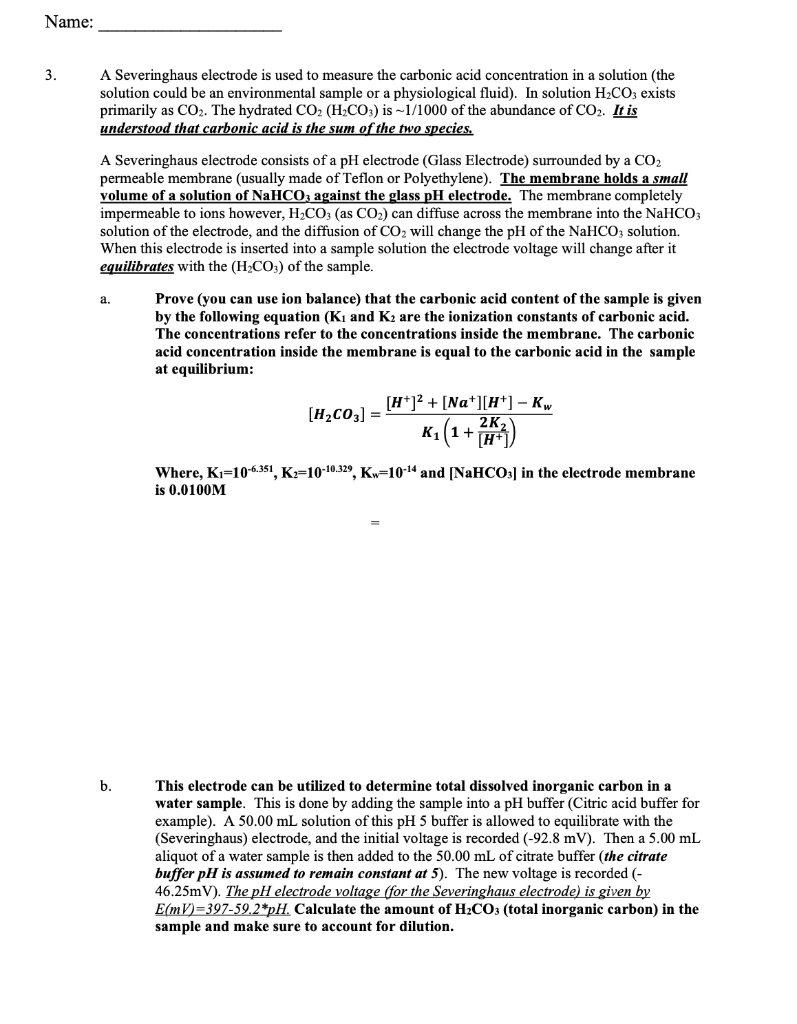
Name: 3. A Severinghaus electrode is used to measure the carbonic acid concentration in a solution (the solution could be an environmental sample or a physiological fluid). In solution H2CO3 exists primarily as CO2. The hydrated CO2 (H.CO) is -1/1000 of the abundance of CO2. It is understood that carbonic acid is the sum of the two species. A Severinghaus electrode consists of a pH electrode (Glass Electrode) surrounded by a CO2 permeable membrane (usually made of Teflon or Polyethylene). The membrane holds a small volume of a solution of NaHCO3 against the glass pH electrode. The membrane completely impermeable to ions however, H CO; (as CO2) can diffuse across the membrane into the NaHCO3 solution of the electrode, and the diffusion of CO2 will change the pH of the NaHCO3 solution. When this electrode is inserted into a sample solution the electrode voltage will change after it equilibrates with the (H2CO3) of the sample. a. Prove (you can use ion balance) that the carbonic acid content of the sample is given by the following equation (Ki and K2 are the ionization constants of carbonic acid. The concentrations refer to the concentrations inside the membrane. The carbonic acid concentration inside the membrane is equal to the carbonic acid in the sample at equilibrium: [H]? + [Na+][H+] - Kw [H2CO3] = 2K K + Where, Kı=10-6.351, K2=10-10.329, Kw=10-14 and [NaHCO3) in the electrode membrane is 0.0100M b. This electrode can be utilized to determine total dissolved inorganic carbon in a water sample. This is done by adding the sample into a pH buffer (Citric acid buffer for example). A 50.00 mL solution of this pH 5 buffer is allowed to equilibrate with the (Severinghaus) electrode, and the initial voltage is recorded (-92.8 mV). Then a 5.00 mL aliquot of a water sample is then added to the 50.00 mL of citrate buffer (the citrate buffer pH is assumed to remain constant at The new voltage is recorded (- 46.25mV). The pH electrode voltage (for the Severinghaus electrode) is given by E(mV)=397-59.2*pH. Calculate the amount of H2CO3 (total inorganic carbon) in the sample and make sure to account for dilution.