Page 1 of 1
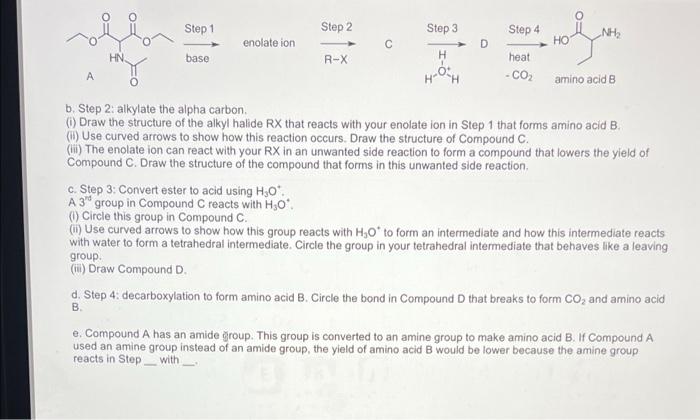
Step 1 Step 2 Step 3 Step 4 NH enolate ion D HO HN H base R-X heat -CO2 A "Η amino acid B b. Step 2: alkylate the alpha
Posted: Tue May 17, 2022 12:02 pm
by answerhappygod
- 1 (39.54 KiB) Viewed 55 times
Step 1 Step 2 Step 3 Step 4 NH enolate ion D HO HN H base R-X heat -CO2 A "Η amino acid B b. Step 2: alkylate the alpha carbon. Draw the structure of the alkyl halide RX that reacts with your enolate ion in Step 1 that forms amino acid B. (W) Use curved arrows to show how this reaction occurs. Draw the structure of Compound C. (1) The enolate ion can react with your RX in an unwanted side reaction to form a compound that lowers the yield of Compound C. Draw the structure of the compound that forms in this unwanted side reaction C. Step 3: Convert ester to acid using H30 A 3" group in Compound C reacts with H30* (1) Circle this group in Compound C. (1) Use curved arrows to show how group reacts with H,0* to form an intermediate and how this intermediate reacts with water to form a tetrahedral intermediate Circle the group in your tetrahedral intermediate that behaves like a leaving group (II) Draw Compound D d. Step 4: decarboxylation to form amino acid B. Circle the bond in Compound that breaks to form Co, and amino acid B e. Compound A has an amide group. This group is converted to an amine group to make amino acid B. If Compound A used an amine group instead of an amide group, the yield of amino acid B would be lower because the amine group reacts in Stop with