Page 1 of 1
AH AI B C D E F G Determine the correct identity for each salt. Each Unknown set contains salts. Every reaction is done
Posted: Tue May 17, 2022 11:47 am
by answerhappygod
- Ah Ai B C D E F G Determine The Correct Identity For Each Salt Each Unknown Set Contains Salts Every Reaction Is Done 1 (74.58 KiB) Viewed 74 times
- Ah Ai B C D E F G Determine The Correct Identity For Each Salt Each Unknown Set Contains Salts Every Reaction Is Done 2 (64.9 KiB) Viewed 74 times
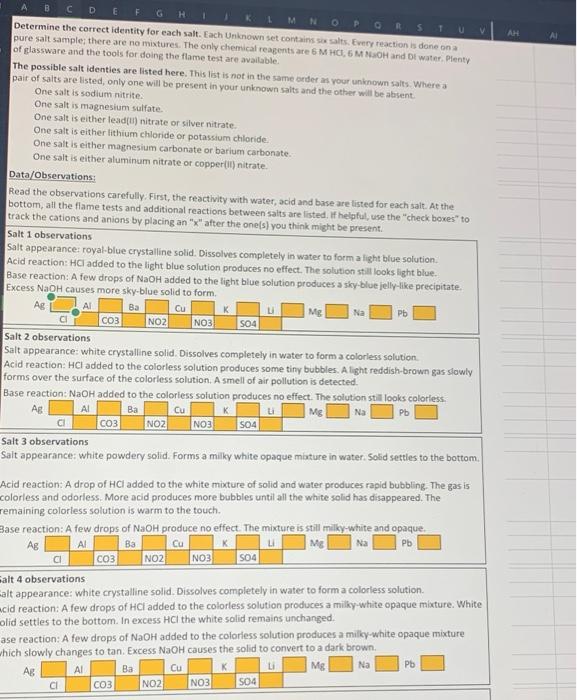
AH AI B C D E F G Determine the correct identity for each salt. Each Unknown set contains salts. Every reaction is done on a NO V pure salt sample; there are no mixtures. The only chemical reagents are SMHI, 6 MNOH and water. Plenty of glassware and the tools for doing the flame test are available The possible satt identies are listed here. This list is not in the same order as your unknown salts. Where a pair of salts are listed, only one will be present in your unknown salts and the other will be absent. One salt is sodium nitrite. One salt is magnesium sulfate One salt is either lead(ul) nitrate or silver nitrate One salt is either lithium chloride or potassium chloride One salt is either magnesium carbonate or barium carbonate. One salt is either aluminum nitrate or copper (1) nitrate Data/Observations: Read the observations carefully. First, the reactivity with water, acid and base are listed for each salt. At the bottom, all the flame tests and additional reactions between salts are listed. It helpful, use the "check boxes to track the cations and anions by placing an "x after the one(s) you think might be present. Salt 1 observations Salt appearance: royal-blue crystalline solid. Dissolves completely in water to form a light blue solution Acid reaction: HCl added to the light blue solution produces no effect. The solution still looks light blue. Base reaction: A few drops of NaOH added to the light blue solution produces a sky-blue jelly-like precipitate. Excess NaOH causes more sky-blue solid to form. Ag AI Ba Cu K Mg Na Pb cl CO3 NOZ NO3 SO4 Salt 2 observations Salt appearance: white crystalline solid. Dissolves completely in water to form a colorless solution Acid reaction: HCI added to the colorless solution produces some tiny bubbles. A light reddish brown gas slowly forms over the surface of the colorless solution. A smell of air pollution is detected Base reaction: NaOH added to the colorless solution produces no effect. The solution still looks colorless AB | Al Ba Cu к ui Mg Na Pb CI CO3 NOZ NO3 504 Salt 3 observations Salt appearance: white powdery solid. Forms a milky white opaque misture in water. Solid settles to the bottom. a Acid reaction: A drop of HCl added to the white mixture of solid and water produces rapid bubbling. The gas is colorless and odorless. More acid produces more bubbles until all the white solid has disappeared. The remaining colorless solution is warm to the touch. Base reaction: A few drops of NaOH produce no effect. The mixture is still milky-white and opaque, Ag AI Ba Cu ME Na Pb CO3 NO2 NO3 SO4 alt 4 observations alt appearance: white crystalline solid. Dissolves completely in water to form a colorless solution acid reaction: A few drops of HCl added to the colorless solution produces a milky white opaque mixture. White olid settles to the bottom. In excess HCl the white solid remains unchanged. ase reaction: A few drops of NaOH added to the colorless solution produces a milky white opaque mixture which slowly changes to tan. Excess NaOH causes the solid to convert to a dark brown Ag AI Cu Mg CO3 NO2 NO3 SO4 Ba K Pb Na 디
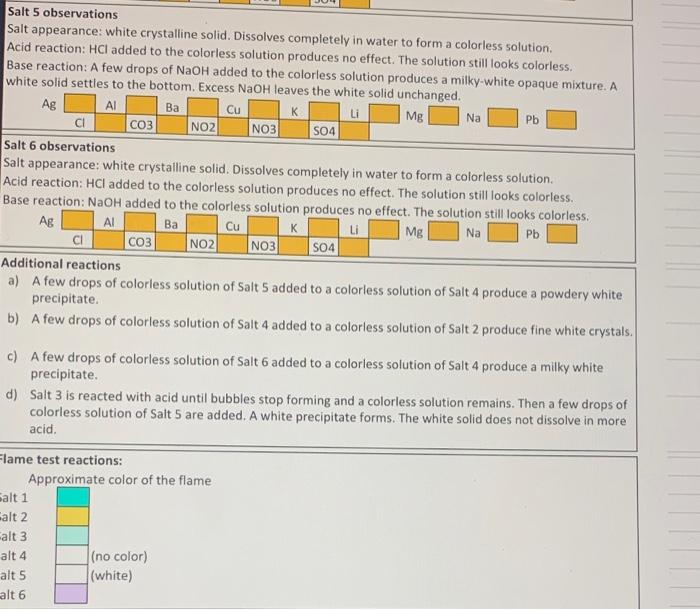
NO3 Salt 5 observations Salt appearance: white crystalline solid. Dissolves completely in water to form a colorless solution. Acid reaction: HCI added to the colorless solution produces no effect. The solution still looks colorless. Base reaction: A few drops of NaOH added to the colorless solution produces a milky white opaque mixture. A white solid settles to the bottom. Excess NaOH leaves the white solid unchanged. Ag AI Ba Cu K Li Mg Na Pb CI CO3 NO2 SO4 Salt 6 observations Salt appearance: white crystalline solid. Dissolves completely in water to form a colorless solution. Acid reaction: HCl added to the colorless solution produces no effect. The solution still looks colorless. Base reaction: NaOH added to the colorless solution produces no effect. The solution still looks colorless. Ag ΑΙ Cu K LI Mg Na РЫ CI CO3 NO2 NO3 s04 Additional reactions a) A few drops of colorless solution of Salt 5 added to a colorless solution of Salt 4 produce a powdery white precipitate. b) A few drops of colorless solution of Salt 4 added to a colorless solution of Salt 2 produce fine white crystals. Ba c) A few drops of colorless solution of Salt 6 added to a colorless solution of Salt 4 produce a milky white precipitate. d) Salt 3 is reacted with acid until bubbles stop forming and a colorless solution remains. Then a few drops of colorless solution of Salt 5 are added. A white precipitate forms. The white solid does not dissolve in more acid. Flame test reactions: Approximate color of the flame Salt 1 alt 2 alt 3 alt 4 (no color) alt 5 (white) alt 6