Page 1 of 1
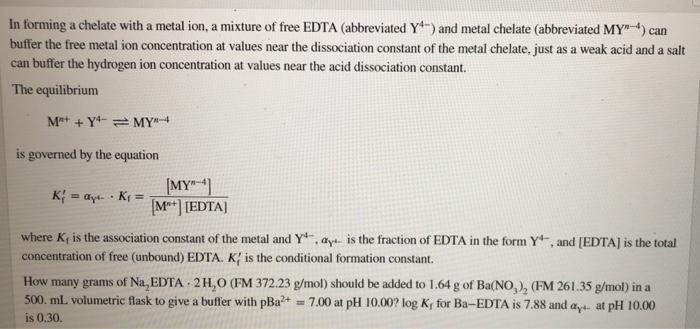
In forming a chelate with a metal ion, a mixture of free EDTA (abbreviated Y4) and metal chelate (abbreviated MY") can b
Posted: Tue May 17, 2022 8:55 am
by answerhappygod
- In Forming A Chelate With A Metal Ion A Mixture Of Free Edta Abbreviated Y4 And Metal Chelate Abbreviated My Can B 1 (38.91 KiB) Viewed 59 times

- In Forming A Chelate With A Metal Ion A Mixture Of Free Edta Abbreviated Y4 And Metal Chelate Abbreviated My Can B 2 (7.31 KiB) Viewed 59 times
In forming a chelate with a metal ion, a mixture of free EDTA (abbreviated Y4) and metal chelate (abbreviated MY") can buffer the free metal ion concentration at values near the dissociation constant of the metal chelate, just as a weak acid and a salt can buffer the hydrogen ion concentration at values near the acid dissociation constant. The equilibrium M*+ + Y-MY-4 is governed by the equation MY"-4) K = dyr. Kr= M*+][EDTA) where Ky is the association constant of the metal and Y4 ay is the fraction of EDTA in the form Y. and [EDTA) is the total concentration of free (unbound) EDTA. Ky is the conditional formation constant How many grams of Na, EDTA 2H,O (FM 372.23 g/mol) should be added to 1.64 g of Ba(NO), (FM 261.35 g/mol) in a 500 mL volumetric flask to give a buffer with pBa²+ = 7.00 at pH 10.00? log Kfor Ba-EDTA is 7.88 and at pH 10.00 is 0.30.
7.77 mass Na, EDTA 2H,O= Incorrect