Page 1 of 1
CHEMICAL EQUILIBRIUM IN A CHEMICAL REACTION PURPOSE The objective of this exercise is to observe the effect of temperatu
Posted: Mon May 16, 2022 9:42 pm
by answerhappygod
- Chemical Equilibrium In A Chemical Reaction Purpose The Objective Of This Exercise Is To Observe The Effect Of Temperatu 1 (36.23 KiB) Viewed 52 times
- Chemical Equilibrium In A Chemical Reaction Purpose The Objective Of This Exercise Is To Observe The Effect Of Temperatu 2 (22.43 KiB) Viewed 52 times
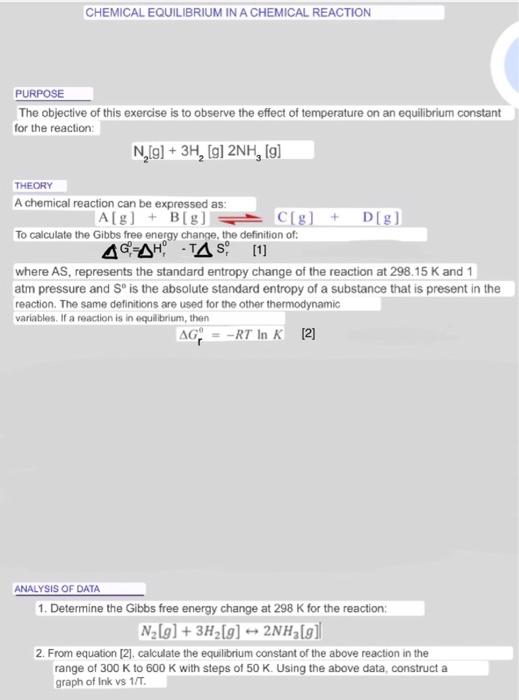
CHEMICAL EQUILIBRIUM IN A CHEMICAL REACTION PURPOSE The objective of this exercise is to observe the effect of temperature on an equilibrium constant for the reaction: N219] + 3H, (g) 2NH, 19] THEORY A chemical reaction can be expressed as: A[g] + B[g] C[!] + D[g) To calculate the Gibbs free energy change the definition of G-AH-TAS [1] where AS, represents the standard entropy change of the reaction at 298.15 K and 1 atm pressure and sº is the absolute standard entropy of a substance that is present in the reaction. The same definitions are used for the other thermodynamic variables. If a reaction is in equilibrium, then AGE -RT In K [2] ANALYSIS OF DATA 1. Determine the Gibbs free energy change at 298 K for the reaction: N2[9] + 3H2(g) - 2NH3[9] 2. From equation (2). calculate the equilibrium constant of the above reaction in the range of 300 K to 600 K with steps of 50 K. Using the above data, construct a graph of Ink vs 1/T.
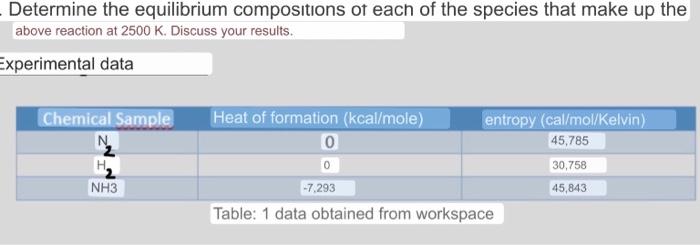
Determine the equilibrium compositions of each of the species that make up the above reaction at 2500 K. Discuss your results. Experimental data Chemical Sample N H NH3 Heat of formation (kcal/mole) entropy (cal/mol/Kelvin) 0 45,785 0 30,758 -7,293 45,843 Table: 1 data obtained from workspace