Page 1 of 1
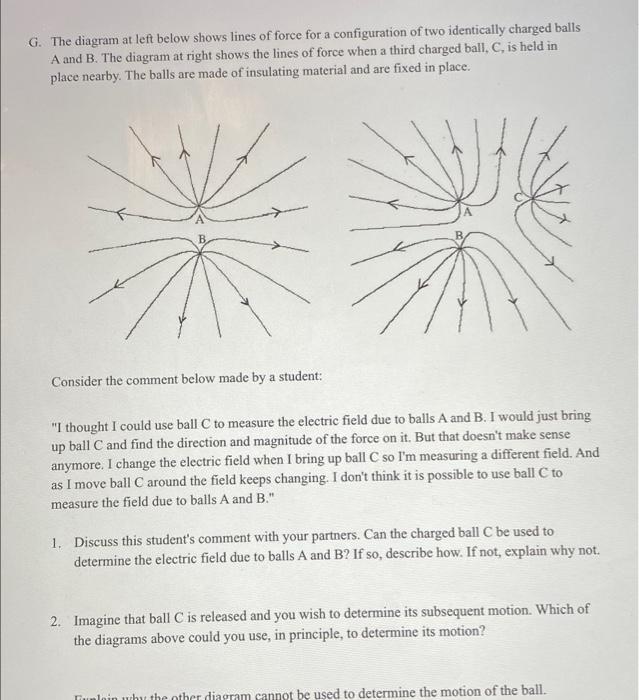
G. The diagram at left below shows lines of force for a configuration of two identically charged balls A and B. The diag
Posted: Mon May 16, 2022 9:11 pm
by answerhappygod
- G The Diagram At Left Below Shows Lines Of Force For A Configuration Of Two Identically Charged Balls A And B The Diag 1 (62.33 KiB) Viewed 57 times
G. The diagram at left below shows lines of force for a configuration of two identically charged balls A and B. The diagram at right shows the lines of force when a third charged ball, C, is held in place nearby. The balls are made of insulating material and are fixed in place. V Consider the comment below made by a student: "I thought I could use ball to measure the electric field due to balls A and B. I would just bring up ball C and find the direction and magnitude of the force on it. But that doesn't make sense anymore. I change the electric field when I bring up ball C so I'm measuring a different field. And as I move ball Caround the field keeps changing. I don't think it is possible to use ball C to measure the field due to balls A and B." 1. Discuss this student's comment with your partners. Can the charged ball C be used to determine the electric field due to balls A and B? If so, describe how. If not, explain why not. 2. Imagine that ball C is released and you wish to determine its subsequent motion. Which of the diagrams above could you use, in principle, to determine its motion? Tumlin uhu the other diagram cannot be used to determine the motion of the ball.