Page 1 of 1
Q1. A person has made a large amount of vegetable stock and has separated it into portions to store. 1.0 kg of the stock
Posted: Mon May 16, 2022 9:01 pm
by answerhappygod
- Q1 A Person Has Made A Large Amount Of Vegetable Stock And Has Separated It Into Portions To Store 1 0 Kg Of The Stock 1 (195.6 KiB) Viewed 37 times
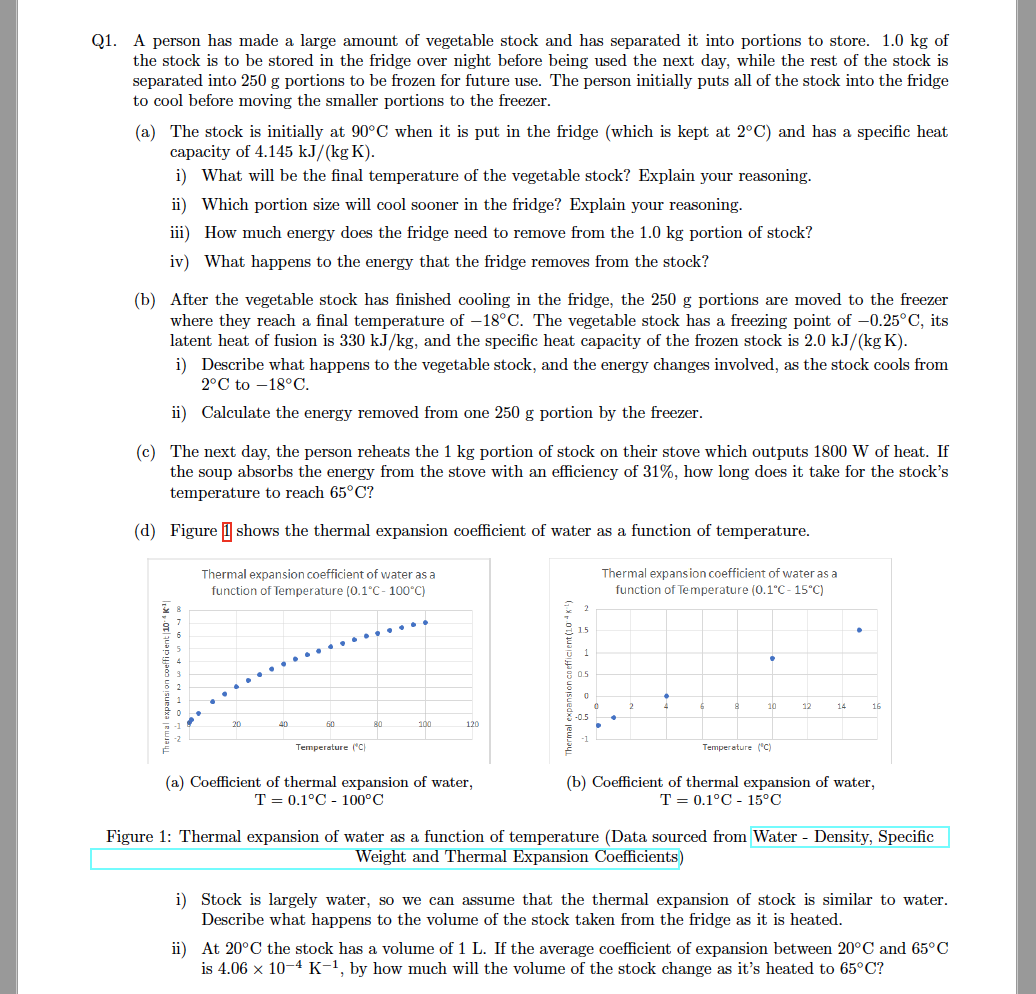
Q1. A person has made a large amount of vegetable stock and has separated it into portions to store. 1.0 kg of the stock is to be stored in the fridge over night before being used the next day, while the rest of the stock is separated into 250 g portions to be frozen for future use. The person initially puts all of the stock into the fridge to cool before moving the smaller portions to the freezer. (a) The stock is initially at 90°C when it is put in the fridge (which is kept at 2°C) and has a specific heat capacity of 4.145 kJ/(kg K). i) What will be the final temperature of the vegetable stock? Explain your reasoning. ii) Which portion size will cool sooner in the fridge? Explain your reasoning. iii) How much energy does the fridge need to remove from the 1.0 kg portion of stock? iv) What happens to the energy that the fridge removes from the stock? (b) After the vegetable stock has finished cooling in the fridge, the 250 g portions are moved to the freezer where they reach a final temperature of -18°C. The vegetable stock has a freezing point of -0.25°C, its latent heat of fusion is 330 kJ/kg, and the specific heat capacity of the frozen stock is 2.0 kJ/(kg K). i) Describe what happens to the vegetable stock, and the energy changes involved, as the stock cools from 2°C to -18°C. ii) Calculate the energy removed from one 250 g portion by the freezer. (c) The next day, the person reheats the 1 kg portion of stock on their stove which outputs 1800 W of heat. If the soup absorbs the energy from the stove with an efficiency of 31%, how long does it take for the stock's temperature to reach 65°C? (d) Figure 7 shows the thermal expansion coefficient of water as a function of temperature. Thermal expansion coefficient of water as a function of Temperature (0.1°C - 100°C) Thermal expansion coefficient of water as a function of Temperature (0.1°C -15°C) 2 15 2 4 05 8 10 12 14 16 X-05 100 120 Temperature (°C) Temperature (°C) (a) Coefficient of thermal expansion of water, T= 0.1°C - 100°C (b) Coefficient of thermal expansion of water, T = 0.1°C -15°C Figure 1: Thermal expansion of water as a function of temperature (Data sourced from Water - Density, Specific Weight and Thermal Expansion Coefficients) i) Stock is largely water, so we can assume that the thermal expansion of stock is similar to water. Describe what happens to the volume of the stock taken from the fridge as it is heated. ii) At 20°C the stock has a volume of 1 L. If the average coefficient of expansion between 20°C and 65°C is 4.06 x 10⁻⁴ K-1, by how much will the volume of the stock change as it's heated to 65°C?