Page 1 of 1
Fone Part I Peak Static Friction and Kinetic Friction Following the instructions on the Pre-Lab05-Lecture Video and Labo
Posted: Mon May 16, 2022 6:44 pm
by answerhappygod
- Fone Part I Peak Static Friction And Kinetic Friction Following The Instructions On The Pre Lab05 Lecture Video And Labo 1 (84.47 KiB) Viewed 38 times
- Fone Part I Peak Static Friction And Kinetic Friction Following The Instructions On The Pre Lab05 Lecture Video And Labo 2 (84.47 KiB) Viewed 38 times
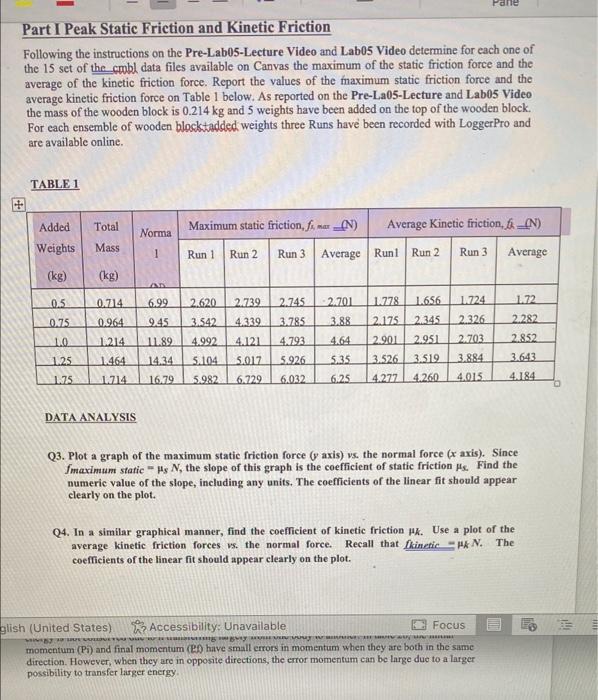
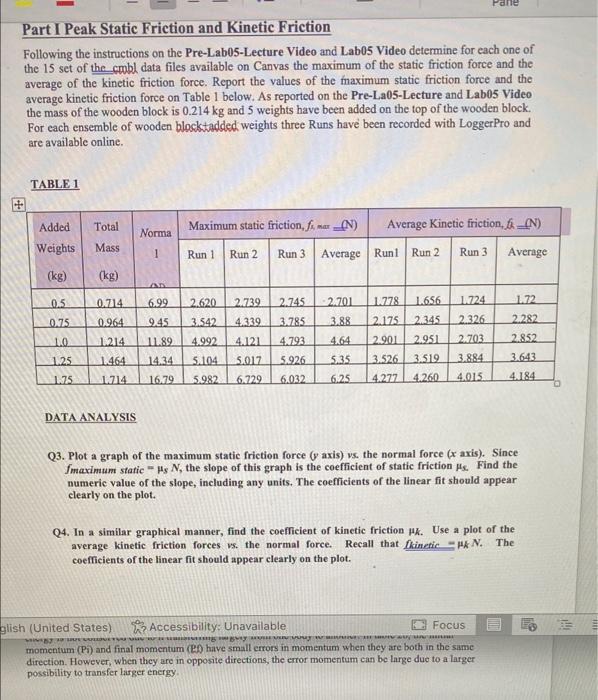
Fone Part I Peak Static Friction and Kinetic Friction Following the instructions on the Pre-Lab05-Lecture Video and Labo5 Video determine for each one of the 15 set of the_cmbl data files available on Canvas the maximum of the static friction force and the average of the kinetic friction force. Report the values of the maximum static friction force and the average kinetic friction force on Table 1 below. As reported on the Pre-La05-Lecture and Labo5 Video the mass of the wooden block is 0.214 kg and 5 weights have been added on the top of the wooden block. For each ensemble of wooden blocktadded weights three Runs have been recorded with LoggerPro and are available online TABLE 1 4: Added Weights Total கன Norma Maximum static friction, fimor-AN) Average Kinetic friction f _{N) Run 1 Run 2 Run 3 Average Run Run 2 Run 3 Average Mass 1 (kg) (kg) 6.99 2.620 0.5 0.75 2.745 3.785 22701 3.88 3.542 2.739 4.339 4.121 0.714 0.964 1.214 1.464 1.714 9.45 111.89 1.724 2.326 2.703 3.884 10 1.72 2.282 2852 4.793 1.778 1.656 2.1752.345 2.901 2.951 3.526 3.519 4.272 4.260 4664 1.25 4.992 5.104 5.982 5.012 14.34 16,79 5.926 5.35 625 1.75 6.229 6.032 4015 4.184 a DATA ANALYSIS Q3. Plot a graph of the maximum static friction force (y axis) vs. the normal force (x axis). Since Imaximum static H N, the slope of this graph is the coefficient of static friction hs. Find the numeric value of the slope, including any units. The coefficients of the linear fit should appear clearly on the plot. Q4. In a similar graphical manner, find the coefficient of kinetic friction 14. Use a plot of the average kinetic friction forces vs. the normal force. Recall that kinetic - HN. The coefficients of the linear fit should appear clearly on the plot. lii glish (United States) Accessibility: Unavailable Focus NEW BV momentum (Pi) and final momentum ( have small errors in momentum when they are both in the same direction. However, when they are in opposite directions, the error momentum can be large due to a larger possibility to transfer larger energy