Page 1 of 1
Synthesis gas (syngas) is a gaseous mixture of predominantly CO and H2 commonly generated via a coal gasification proces
Posted: Mon May 16, 2022 1:58 pm
by answerhappygod
- Synthesis Gas Syngas Is A Gaseous Mixture Of Predominantly Co And H2 Commonly Generated Via A Coal Gasification Proces 1 (83.21 KiB) Viewed 167 times
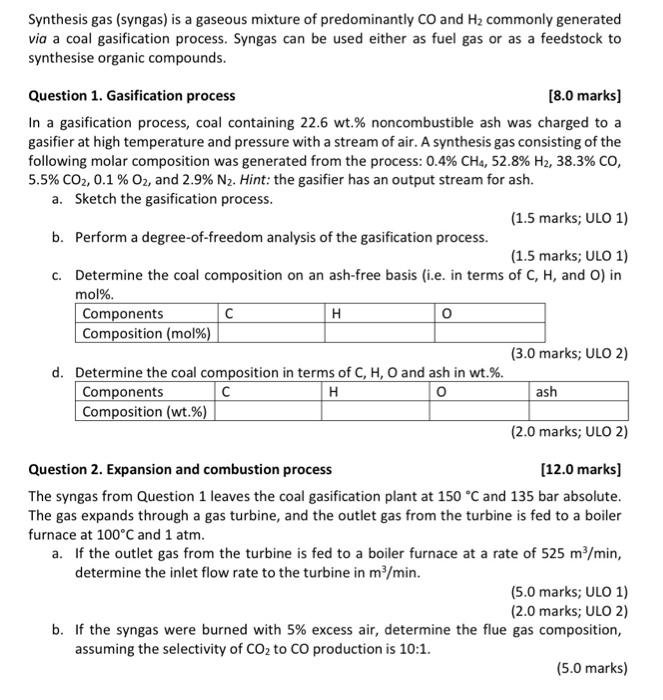
Synthesis gas (syngas) is a gaseous mixture of predominantly CO and H2 commonly generated via a coal gasification process. Syngas can be used either as fuel gas or as a feedstock to synthesise organic compounds. Question 1. Gasification process [8.0 marks) In a gasification process, coal containing 22.6 wt.% noncombustible ash was charged to a gasifier at high temperature and pressure with a stream of air. A synthesis gas consisting of the following molar composition was generated from the process: 0.4% CH4, 52.8% H2, 38.3% co, 5.5% CO2, 0.1 % O2, and 2.9% N2. Hint: the gasifier has an output stream for ash. a. Sketch the gasification process. (1.5 marks; ULO 1) b. Perform a degree-of-freedom analysis of the gasification process. (1.5 marks; ULO 1) c. Determine the coal composition on an ash-free basis (i.e. in terms of C, H, and O) in mol%. Components с H o Composition (mol%) (3.0 marks; ULO 2) d. Determine the coal composition in terms of C, H, O and ash in wt.%. Components с H o ash Composition (wt.%) (2.0 marks; ULO 2) Question 2. Expansion and combustion process [12.0 marks) The syngas from Question 1 leaves the coal gasification plant at 150 °C and 135 bar absolute. The gas expands through a gas turbine, and the outlet gas from the turbine is fed to a boiler furnace at 100°C and 1 atm. a. If the outlet gas from the turbine is fed to a boiler furnace at a rate of 525 m/min, determine the inlet flow rate to the turbine in m/min. (5.0 marks; ULO 1) (2.0 marks; ULO 2) b. If the syngas were burned with 5% excess air, determine the flue gas composition, assuming the selectivity of CO2 to CO production is 10:1. (5.0 marks)