Page 1 of 1
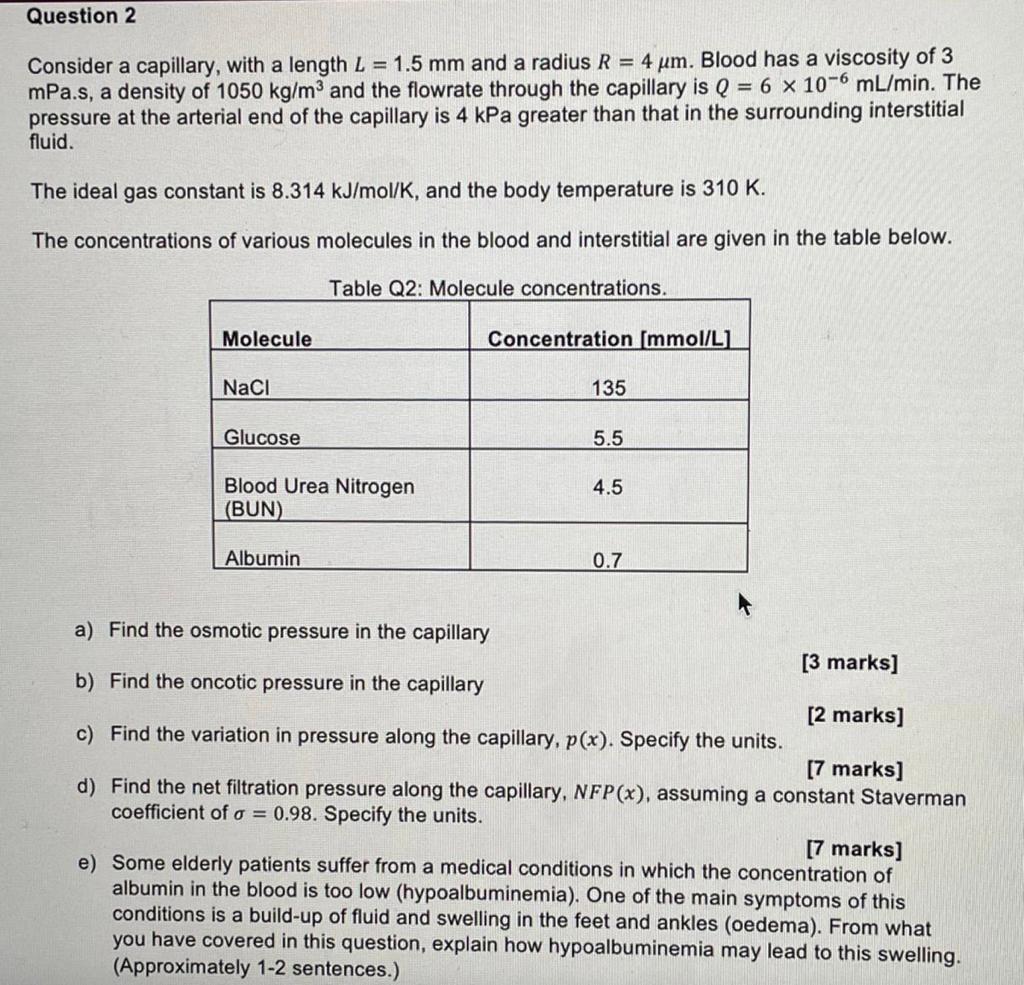
Question 2 Consider a capillary, with a length L = 1.5 mm and a radius R = 4 um. Blood has a viscosity of 3 mPa.s, a den
Posted: Mon May 16, 2022 1:54 pm
by answerhappygod
- Question 2 Consider A Capillary With A Length L 1 5 Mm And A Radius R 4 Um Blood Has A Viscosity Of 3 Mpa S A Den 1 (172.27 KiB) Viewed 29 times
Question 2 Consider a capillary, with a length L = 1.5 mm and a radius R = 4 um. Blood has a viscosity of 3 mPa.s, a density of 1050 kg/m3 and the flowrate through the capillary is Q = 6 x 10⁻⁶ mL/min. The pressure at the arterial end of the capillary is 4 kPa greater than that in the surrounding interstitial fluid. The ideal gas constant is 8.314 kJ/mol/K, and the body temperature is 310 K. The concentrations of various molecules in the blood and interstitial are given in the table below. Table Q2: Molecule concentrations, Molecule Concentration (mmol/L) NaCl 135 Glucose 5.5 4.5 Blood Urea Nitrogen (BUN). Albumin 0.7 a) Find the osmotic pressure in the capillary [3 marks] b) Find the oncotic pressure in the capillary [2 marks] c) Find the variation in pressure along the capillary, p(x). Specify the units. [7 marks] d) Find the net filtration pressure along the capillary, NFP(x), assuming a constant Staverman coefficient of o = 0.98. Specify the units. [7 marks] e) Some elderly patients suffer from a medical conditions in which the concentration of albumin in the blood is too low (hypoalbuminemia). One of the main symptoms of this conditions is a build-up of fluid and swelling in the feet and ankles (oedema). From what you have covered in this question, explain how hypoalbuminemia may lead to this swelling. (Approximately 1-2 sentences.)