Page 1 of 1
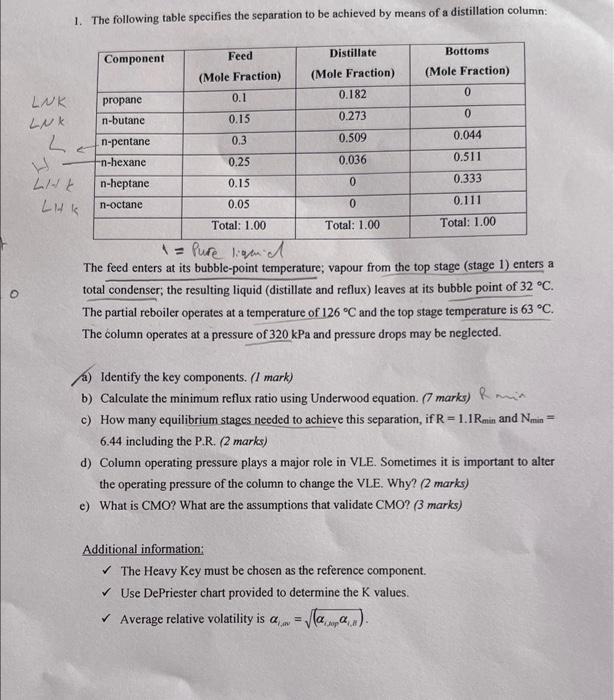
1. The following table specifies the separation to be achieved by means of a distillation column: Component Feed Distill
Posted: Mon May 16, 2022 1:04 pm
by answerhappygod
- 1 The Following Table Specifies The Separation To Be Achieved By Means Of A Distillation Column Component Feed Distill 1 (72.02 KiB) Viewed 50 times
1. The following table specifies the separation to be achieved by means of a distillation column: Component Feed Distillate Bottoms (Mole Fraction) (Mole Fraction) (Mole Fraction) LNK propane 0.1 0.182 0 LNX n-butane 0.15 0.273 0 L n-pentane 0.3 0.509 0.044 n-hexane 0.25 0.036 0.511 Liik n-heptane 0.15 0 0.333 LHK n-octane 0.05 0 0.111 Total: 1.00 Total: 1.00 Total: 1.00 - Pure lighed The feed enters at its bubble-point temperature; vapour from the top stage (stage 1) enters a total condenser, the resulting liquid (distillate and reflux) leaves at its bubble point of 32 °C. The partial reboiler operates at a temperature of 126 °C and the top stage temperature is 63 °C. The column operates at a pressure of 320 kPa and pressure drops may be neglected. a) Identify the key components. (1 mark) b) Calculate the minimum reflux ratio using Underwood equation. (7 marks) R min c) How many equilibrium stages needed to achieve this separation, if R - 1.1 Rmin and Nmin = 6.44 including the P.R. (2 marks) d) Column operating pressure plays a major role in VLE. Sometimes it is important to alter the operating pressure of the column to change the VLE. Why? (2 marks) e) What is CMO? What are the assumptions that validate CMO? (3 marks) Additional information: The Heavy Key must be chosen as the reference component. Use De Priester chart provided to determine the K values Average relative volatility is a = Jama). Cop