Page 1 of 1
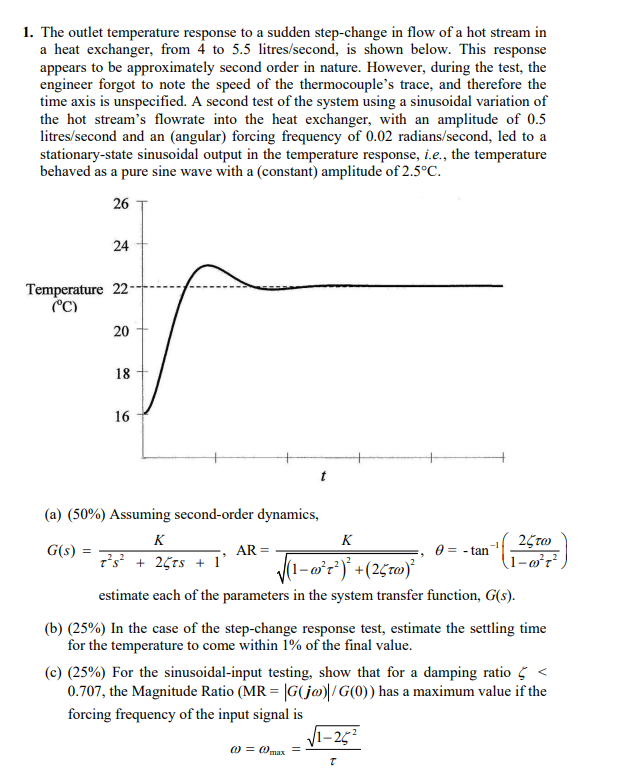
1. The outlet temperature response to a sudden step-change in flow of a hot stream in a heat exchanger, from 4 to 5.5 li
Posted: Mon May 16, 2022 12:52 pm
by answerhappygod
- 1 The Outlet Temperature Response To A Sudden Step Change In Flow Of A Hot Stream In A Heat Exchanger From 4 To 5 5 Li 1 (130.41 KiB) Viewed 57 times
1. The outlet temperature response to a sudden step-change in flow of a hot stream in a heat exchanger, from 4 to 5.5 litres/second, is shown below. This response appears to be approximately second order in nature. However, during the test, the engineer forgot to note the speed of the thermocouple's trace, and therefore the time axis is unspecified. A second test of the system using a sinusoidal variation of the hot stream's flowrate into the heat exchanger, with an amplitude of 0.5 litres/second and an (angular) forcing frequency of 0.02 radians/second, led to a stationary-state sinusoidal output in the temperature response, i.e., the temperature behaved as a pure sine wave with a constant) amplitude of 2.5°C. 26 24 Temperature 22-- (°C) 20 18 16 (a) (50%) Assuming second-order dynamics, K K 2ζτω G(S) AR = O= - tan ?s? + 26ts + 1 V1-oʻ-2)* +(2510) (1-mºr? estimate each of the parameters in the system transfer function, G(s). (b) (25%) In the case of the step-change response test, estimate the settling time for the temperature to come within 1% of the final value. (c) (25%) For the sinusoidal-input testing, show that for a damping ratio 5 < 0.707, the Magnitude Ratio (MR = G(0)|/G(0)) has a maximum value if the forcing frequency of the input signal is VI-262 (= max T