Page 1 of 1
7. Statics, Equilibrium, and Member forces A fixed end beam has: A. The ability to rotate at the point of support B. The
Posted: Mon May 16, 2022 12:19 pm
by answerhappygod
- 7 Statics Equilibrium And Member Forces A Fixed End Beam Has A The Ability To Rotate At The Point Of Support B The 1 (48.14 KiB) Viewed 67 times
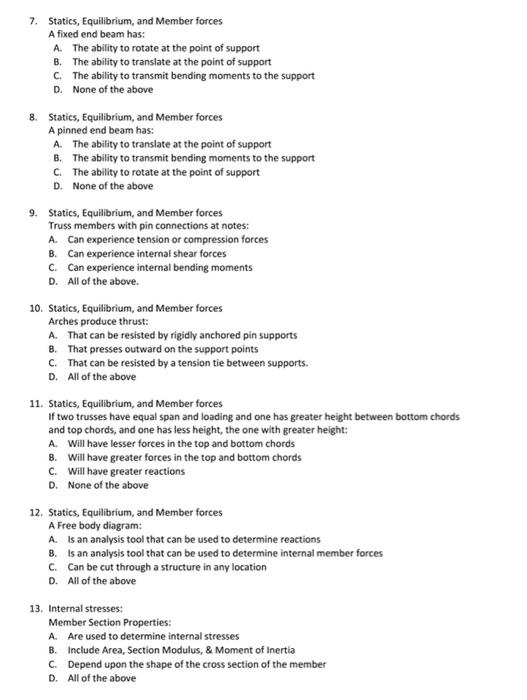
7. Statics, Equilibrium, and Member forces A fixed end beam has: A. The ability to rotate at the point of support B. The ability to translate at the point of support C. The ability to transmit bending moments to the support D. None of the above 8. Statics, Equilibrium, and Member forces A pinned end beam has: A. The ability to translate at the point of support B. The ability to transmit bending moments to the support C. The ability to rotate at the point of support D. None of the above 9. Statics, Equilibrium, and Member forces Truss members with pin connections at notes: A. Can experience tension or compression forces B. Can experience internal shear forces C.Can experience internal bending moments D. All of the above. 10. Statics, Equilibrium, and Member forces Arches produce thrust: A. That can be resisted by rigidly anchored pin supports B. That presses outward on the support points C. That can be resisted by a tension tie between supports D. All of the above 11. Statics, Equilibrium, and Member forces if two trusses have equal span and loading and one has greater height between bottom chords and top chords, and one has less height, the one with greater height: A. Will have lesser forces in the top and bottom chords 8. Will have greater forces in the top and bottom chords C. Will have greater reactions D. None of the above 12. Statics, Equilibrium, and Member forces A Free body diagram: A. Is an analysis tool that can be used to determine reactions B. Is an analysis tool that can be used to determine internal member forces C. Can be cut through a structure in any location D. All of the above 13. Internal stresses: Member Section Properties: A. Are used to determine internal stresses B. Include Area, Section Modulus, & Moment of Inertia C. Depend upon the shape of the cross section of the member D. All of the above