Page 1 of 1
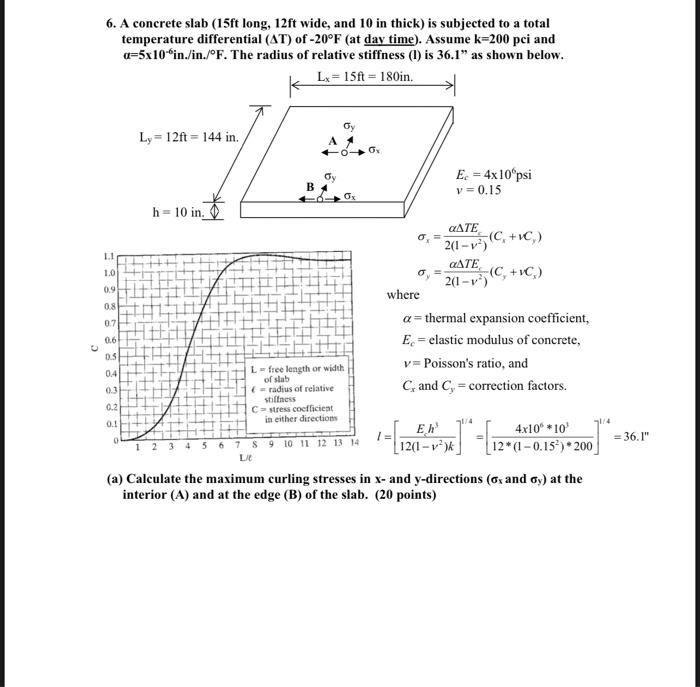
6. A concrete slab (15ft long, 12ft wide, and 10 in thick) is subjected to a total temperature differential (AT) of -20°
Posted: Mon May 16, 2022 8:10 am
by answerhappygod
- 6 A Concrete Slab 15ft Long 12ft Wide And 10 In Thick Is Subjected To A Total Temperature Differential At Of 20 1 (55.09 KiB) Viewed 43 times
- 6 A Concrete Slab 15ft Long 12ft Wide And 10 In Thick Is Subjected To A Total Temperature Differential At Of 20 2 (20.91 KiB) Viewed 43 times
6. A concrete slab (15ft long, 12ft wide, and 10 in thick) is subjected to a total temperature differential (AT) of -20°F (at day time). Assume k=200 pci and a=5x10-in./in./°F. The radius of relative stiffness (1) is 36.1" as shown below. Lx = 15ft = 180in. Ly=12ft = 144 in. O Oy B, OX E = 4x 10psi v = 0.15 h=10 in. 1.1 1.0 0.9 08 αΔΤΕ 2(1-v) C, +vC) αΔΤΕ. C + VC) 2(1-v) where a=thermal expansion coefficient, E = elastic modulus of concrete, v=Poisson's ratio, and C and C, -correction factors. 0.7 0.6 05 0.4 0.3 L-free length or width of slab radius of relative stiffness C-stress coefficient in either directions 0.2 0.1 -- * - [ ] 0 ER 12(1-v) 4x10*10 12*(1 -0.15). 200 = 36.1" 1 2 3 4 5 6 7 8 9 10 11 12 13 14 LIC (a) Calculate the maximum curling stresses in x- and y-directions (Ox and Oy) at the interior (A) and at the edge (B) of the slab. (20 points)
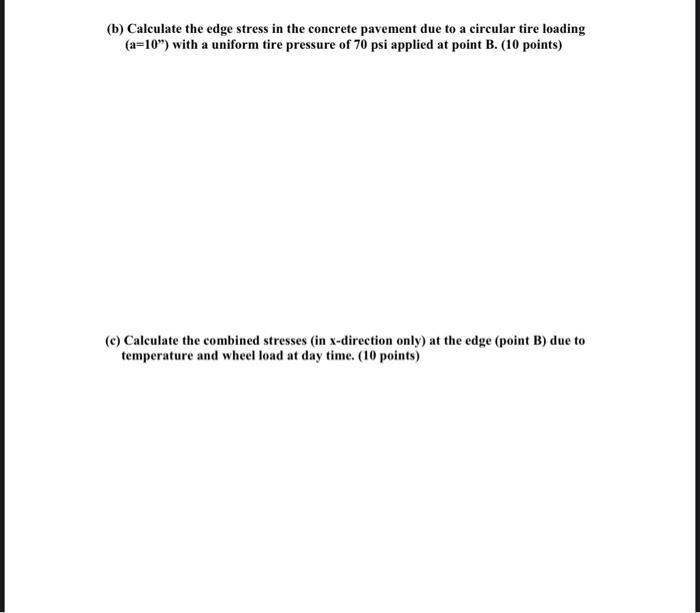
(b) Calculate the edge stress in the concrete pavement due to a circular tire loading (a=10") with a uniform tire pressure of 70 psi applied at point B. (10 points) (c) Calculate the combined stresses (in x-direction only) at the edge (point B) due to temperature and wheel load at day time. (10 points)