Page 1 of 1
1. A conventional consolidated-drained (CD) triaxial test is conducted on a sand. The cell pressure is 100 kPa and the a
Posted: Mon May 16, 2022 7:37 am
by answerhappygod
- 1 A Conventional Consolidated Drained Cd Triaxial Test Is Conducted On A Sand The Cell Pressure Is 100 Kpa And The A 1 (79.87 KiB) Viewed 40 times
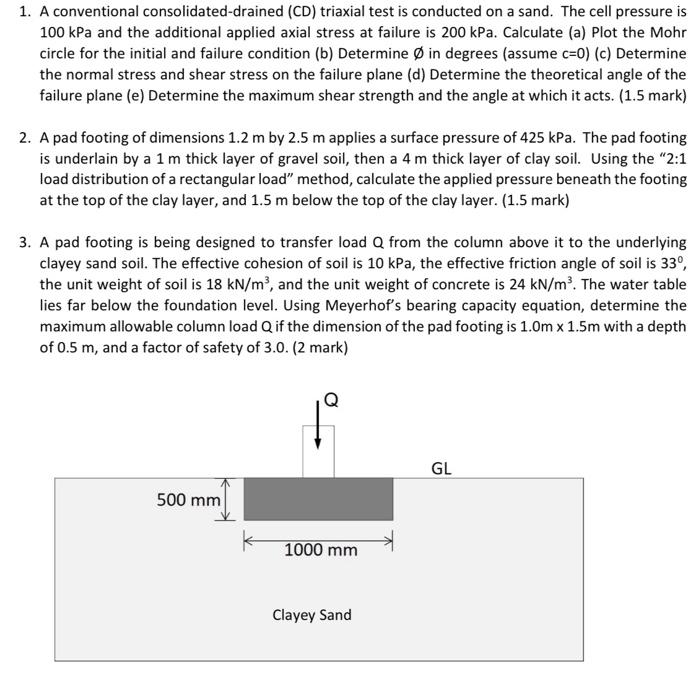
1. A conventional consolidated-drained (CD) triaxial test is conducted on a sand. The cell pressure is 100 kPa and the additional applied axial stress at failure is 200 kPa. Calculate (a) Plot the Mohr circle for the initial and failure condition (b) Determine Ø in degrees (assume c=0) (c) Determine the normal stress and shear stress on the failure plane (d) Determine the theoretical angle of the failure plane (e) Determine the maximum shear strength and the angle at which it acts. (1.5 mark) 2. A pad footing of dimensions 1.2 m by 2.5 m applies a surface pressure of 425 kPa. The pad footing is underlain by a 1 m thick layer of gravel soil, then a 4 m thick layer of clay soil. Using the "2:1 load distribution of a rectangular load" method, calculate the applied pressure beneath the footing at the top of the clay layer, and 1.5 m below the top of the clay layer. (1.5 mark) 3. A pad footing is being designed to transfer load Q from the column above it to the underlying clayey sand soil. The effective cohesion of soil is 10 kPa, the effective friction angle of soil is 33°, the unit weight of soil is 18 kN/mº, and the unit weight of concrete is 24 kN/m?. The water table lies far below the foundation level. Using Meyerhof's bearing capacity equation, determine the maximum allowable column load Q if the dimension of the pad footing is 1.0m x 1.5m with a depth of 0.5 m, and a factor of safety of 3.0. (2 mark) GL 500 mm 1000 mm Clayey Sand