Page 1 of 1
The single degree of freedom spring-mass-damper system has mass m, stiffness k and viscous damping coefficient c. When a
Posted: Mon May 16, 2022 7:23 am
by answerhappygod
- The Single Degree Of Freedom Spring Mass Damper System Has Mass M Stiffness K And Viscous Damping Coefficient C When A 1 (66.94 KiB) Viewed 63 times
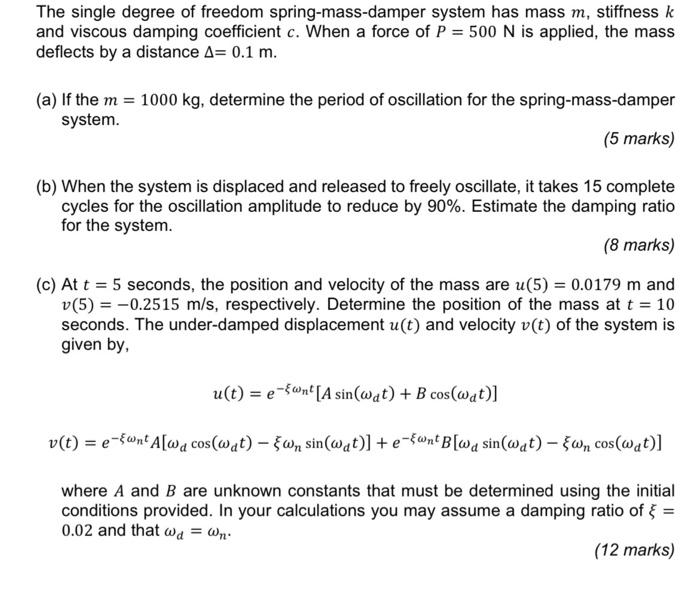
The single degree of freedom spring-mass-damper system has mass m, stiffness k and viscous damping coefficient c. When a force of P = 500 N is applied, the mass deflects by a distance A= 0.1 m. (a) If the m = 1000 kg, determine the period of oscillation for the spring-mass-damper system. (5 marks) (b) When the system is displaced and released to freely oscillate, it takes 15 complete cycles for the oscillation amplitude to reduce by 90%. Estimate the damping ratio for the system. (8 marks) (c) At t = 5 seconds, the position and velocity of the mass are u(5) = 0.0179 m and v(5) = -0.2515 m/s, respectively. Determine the position of the mass at t = 10 seconds. The under-damped displacement u(t) and velocity v(t) of the system is given by, u(t) = e-£wn[A sin(wat) + B cos(wat)] v(t) = e-£wnt A[wd cos(wat) - {wn sin(Wdt)] + e-£Wnt B[Wd sin(Wat) - {wn cos(Wdt)] where A and B are unknown constants that must be determined using the initial conditions provided. In your calculations you may assume a damping ratio of & = 0.02 and that wd = Wn. (12 marks)