Page 1 of 1
In our class, we examined a columbium skirt (emissivity at 0.9) used as a nozzle expansion on a space engine. If you rec
Posted: Mon May 16, 2022 6:14 am
by answerhappygod
- In Our Class We Examined A Columbium Skirt Emissivity At 0 9 Used As A Nozzle Expansion On A Space Engine If You Rec 1 (102.36 KiB) Viewed 51 times
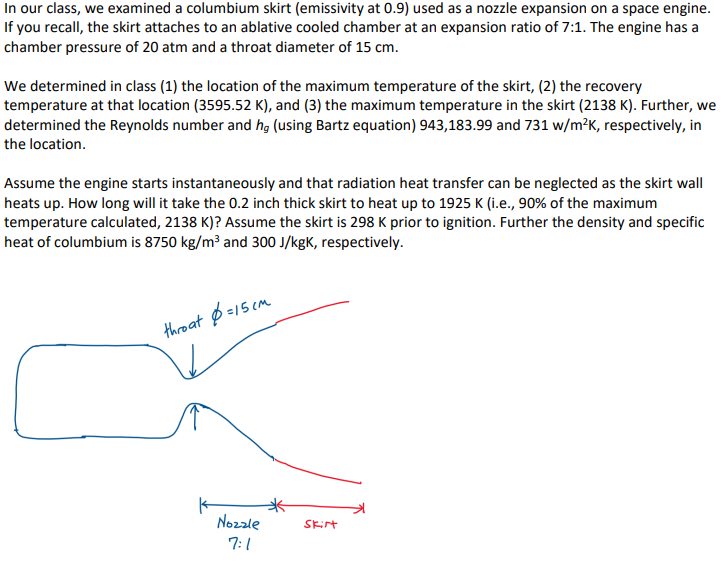
In our class, we examined a columbium skirt (emissivity at 0.9) used as a nozzle expansion on a space engine. If you recall, the skirt attaches to an ablative cooled chamber at an expansion ratio of 7:1. The engine has a chamber pressure of 20 atm and a throat diameter of 15 cm. We determined in class (1) the location of the maximum temperature of the skirt, (2) the recovery temperature at that location (3595.52 K), and (3) the maximum temperature in the skirt (2138 K). Further, we determined the Reynolds number and hg (using Bartz equation) 943,183.99 and 731 w/m²K, respectively, in the location. Assume the engine starts instantaneously and that radiation heat transfer can be neglected as the skirt wall heats up. How long will it take the 0.2 inch thick skirt to heat up to 1925 K (i.e., 90% of the maximum temperature calculated, 2138 K)? Assume the skirt is 298 K prior to ignition. Further the density and specific heat of columbium is 8750 kg/m3 and 300 J/kgK, respectively. throat 0=15cm Skirt Nozzle 7:1