Page 1 of 1
Assignment 1. A 4 m diameter long horizontal pipe is in the ocean, elevated off the ocean floor. A large current crosses
Posted: Sun May 15, 2022 11:23 pm
by answerhappygod
- Assignment 1 A 4 M Diameter Long Horizontal Pipe Is In The Ocean Elevated Off The Ocean Floor A Large Current Crosses 1 (132.35 KiB) Viewed 50 times
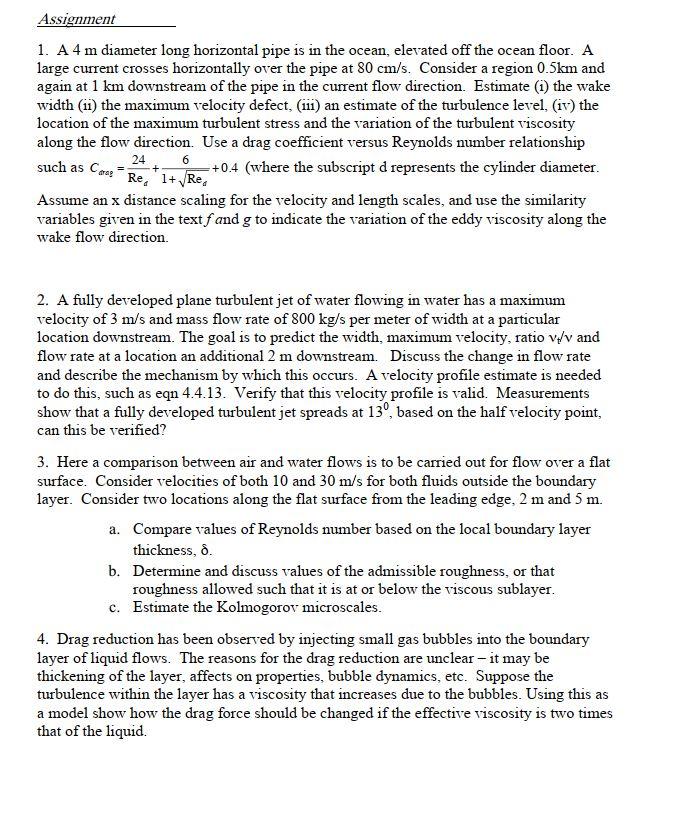
Assignment 1. A 4 m diameter long horizontal pipe is in the ocean, elevated off the ocean floor. A large current crosses horizontally over the pipe at 80 cm/s. Consider a region 0.5km and again at 1 km downstream of the pipe in the current flow direction. Estimate (1) the wake width (11) the maximum velocity defect, (iii) an estimate of the turbulence level, (iv) the location of the maximum turbulent stress and the variation of the turbulent viscosity along the flow direction. Use a drag coefficient versus Reynolds number relationship such as Cores +0.4 (where the subscript d represents the cylinder diameter. Re, 1+ Re, Assume an x distance scaling for the velocity and length scales, and use the similarity variables given in the text f and g to indicate the variation of the eddy viscosity along the wake flow direction. 24 + 6 2. A fully developed plane turbulent jet of water flowing in water has a maximum velocity of 3 m/s and mass flow rate of 800 kg/s per meter of width at a particular location downstream. The goal is to predict the width, maximum velocity, ratio v/v and flow rate at a location an additional 2 m downstream. Discuss the change in flow rate and describe the mechanism by which this occurs. A velocity profile estimate is needed to do this, such as eqn 4.4.13. Verify that this velocity profile is valid. Measurements show that a fully developed turbulent jet spreads at 13', based on the half velocity point, can this be verified? 3. Here a comparison between air and water flows is to be carried out for flow over a flat surface. Consider velocities of both 10 and 30 m/s for both fluids outside the boundary layer. Consider two locations along the flat surface from the leading edge, 2 m and 5 m. a. Compare values of Reynolds number based on the local boundary layer thickness, O. b. Determine and discuss values of the admissible roughness, or that roughness allowed such that it is at or below the viscous sublayer. c. Estimate the Kolmogorov microscales. 4. Drag reduction has been observed by injecting small gas bubbles into the boundary layer of liquid flows. The reasons for the drag reduction are unclear - it may be thickening of the layer, affects on properties, bubble dynamics, etc. Suppose the turbulence within the layer has a viscosity that increases due to the bubbles. Using this as a model show how the drag force should be changed if the effective viscosity is two times that of the liquid.