Page 1 of 1
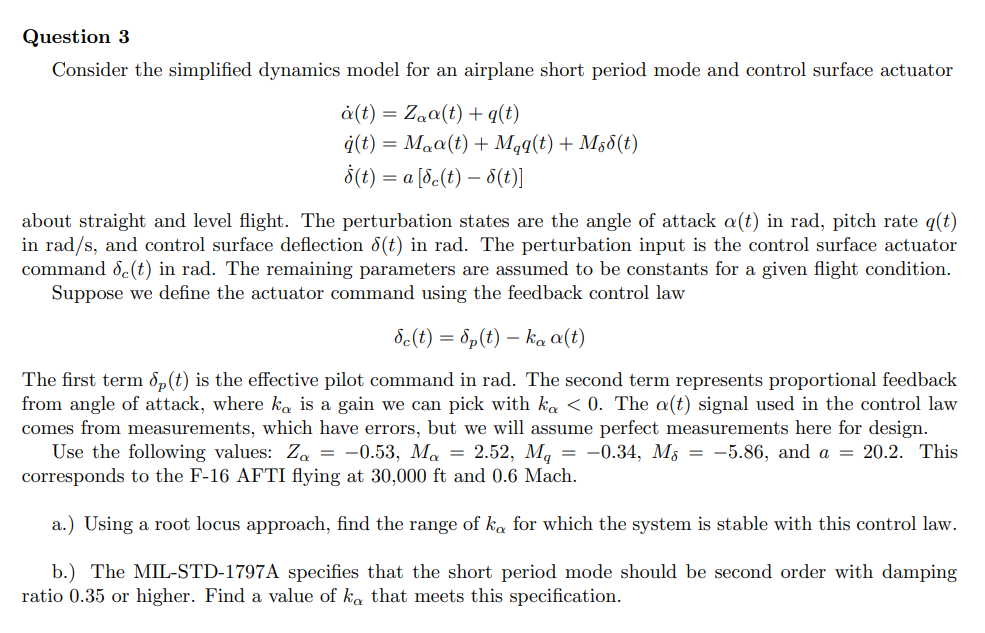
Question 3 Consider the simplified dynamics model for an airplane short period mode and control surface actuator ä(t) =
Posted: Sun May 15, 2022 11:01 pm
by answerhappygod
- Question 3 Consider The Simplified Dynamics Model For An Airplane Short Period Mode And Control Surface Actuator A T 1 (157.55 KiB) Viewed 54 times
Question 3 Consider the simplified dynamics model for an airplane short period mode and control surface actuator ä(t) = 2qa(t) +q(t) ġ(t) = Mqa(t) + Mg(t) + M38(t) Š(t) = a (Sc(t) – 8(t)] about straight and level flight. The perturbation states are the angle of attack a(t) in rad, pitch rate q(t) in rad/s, and control surface deflection (t) in rad. The perturbation input is the control surface actuator command c(t) in rad. The remaining parameters are assumed to be constants for a given flight condition. Suppose we define the actuator command using the feedback control law 8(t) = 8p(t) – ką a(t) The first term 8(t) is the effective pilot command in rad. The second term represents proportional feedback from angle of attack, where ka is a gain we can pick with ka < 0. The at) signal used in the control law comes from measurements, which have errors, but we will assume perfect measurements here for design. Use the following values: Za = -0.53, Ma = 2.52, Mg = -0.34, Mg = -5.86, and a = 20.2. This corresponds to the F-16 AFTI flying at 30,000 ft and 0.6 Mach. a.) Using a root locus approach, find the range of ką for which the system is stable with this control law. b.) The MIL-STD-1797A specifies that the short period mode should be second order with damping ratio 0.35 or higher. Find a value of ka that meets this specification.