Page 1 of 1
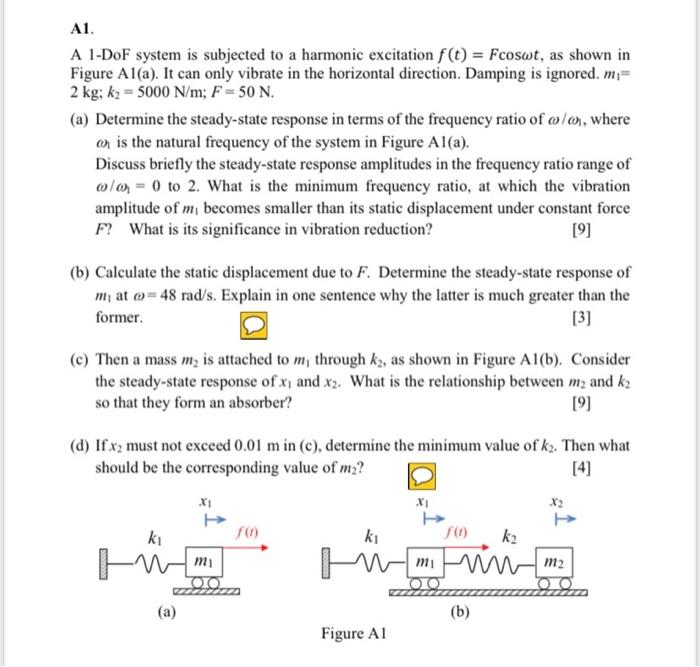
A1. A 1-DoF system is subjected to a harmonic excitation f(t) = Fcoswt, as shown in Figure Al(a). It can only vibrate in
Posted: Sun May 15, 2022 10:49 pm
by answerhappygod
- A1 A 1 Dof System Is Subjected To A Harmonic Excitation F T Fcoswt As Shown In Figure Al A It Can Only Vibrate In 1 (61.02 KiB) Viewed 46 times
A1. A 1-DoF system is subjected to a harmonic excitation f(t) = Fcoswt, as shown in Figure Al(a). It can only vibrate in the horizontal direction. Damping is ignored. m- 2 kg; k= 5000 N/m; F = 50 N. (a) Determine the steady-state response in terms of the frequency ratio of o/m, where on is the natural frequency of the system in Figure Al(a). Discuss briefly the steady-state response amplitudes in the frequency ratio range of 0/0 = 0 to 2. What is the minimum frequency ratio, at which the vibration amplitude of mı becomes smaller than its static displacement under constant force F? What is its significance in vibration reduction? [9] (b) Calculate the static displacement due to F. Determine the steady-state response of mi at a = 48 rad/s. Explain in one sentence why the latter is much greater than the former. [3] (e) Then a mass m2 is attached to m, through k2, as shown in Figure Al(b). Consider the steady-state response of xi and x2. What is the relationship between me and k2 so that they form an absorber? [9] (d) If x2 must not exceed 0.01 m in (e), determine the minimum value of k2. Then what should be the corresponding value of me? [4] ki ki ) k2 ЕЛ minim oo (a) (b) Figure A1