Page 1 of 1
Consider a low-bypass turbojet which has a low-pressure multi-stage compressor at the engine front rather than a large s
Posted: Sun May 15, 2022 10:43 pm
by answerhappygod
- Consider A Low Bypass Turbojet Which Has A Low Pressure Multi Stage Compressor At The Engine Front Rather Than A Large S 1 (91.29 KiB) Viewed 58 times
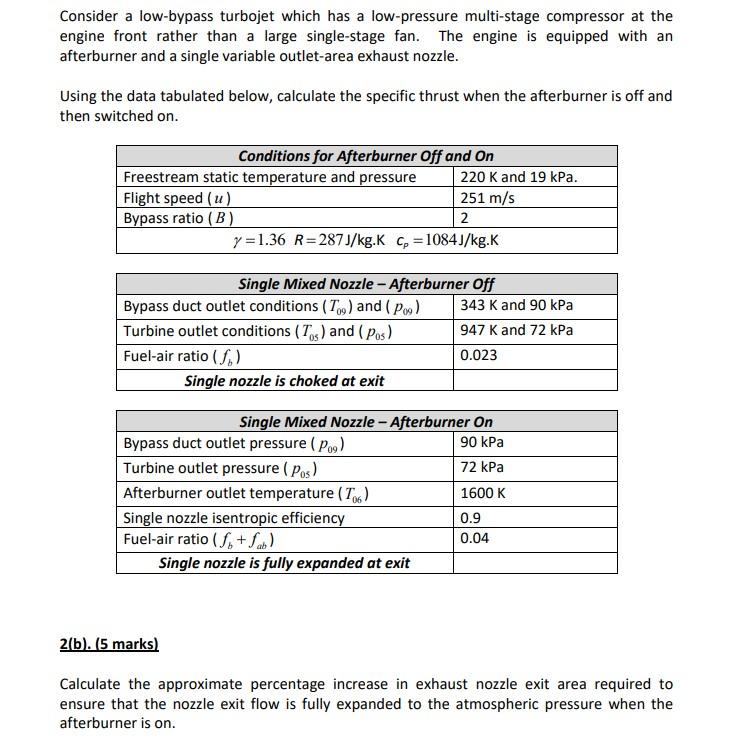
Consider a low-bypass turbojet which has a low-pressure multi-stage compressor at the engine front rather than a large single-stage fan. The engine is equipped with an afterburner and a single variable outlet-area exhaust nozzle. Using the data tabulated below, calculate the specific thrust when the afterburner is off and then switched on. Conditions for Afterburner Off and on Freestream static temperature and pressure 220 K and 19 kPa. Flight speed (u) 251 m/s Bypass ratio (B) 2 y = 1.36 R=287J/kg.K Cp = 1084J/kg.K - Single Mixed Nozzle - Afterburner Off Bypass duct outlet conditions (Toy) and (P) 343 K and 90 kPa Turbine outlet conditions (Ts) and (Pos) 947 K and 72 kPa Fuel-air ratio (8) 0.023 Single nozzle is choked at exit Single Mixed Nozzle - Afterburner On Bypass duct outlet pressure (Pog) 90 kPa Turbine outlet pressure (Pos) 72 kPa Afterburner outlet temperature (76) 1600 K Single nozzle isentropic efficiency 0.9 Fuel-air ratio (S3 + far) 0.04 Single nozzle is fully expanded at exit 2(b). (5 marks) Calculate the approximate percentage increase in exhaust nozzle exit area required to ensure that the nozzle exit flow is fully expanded to the atmospheric pressure when the afterburner is on.